
Master List of Financial Goals
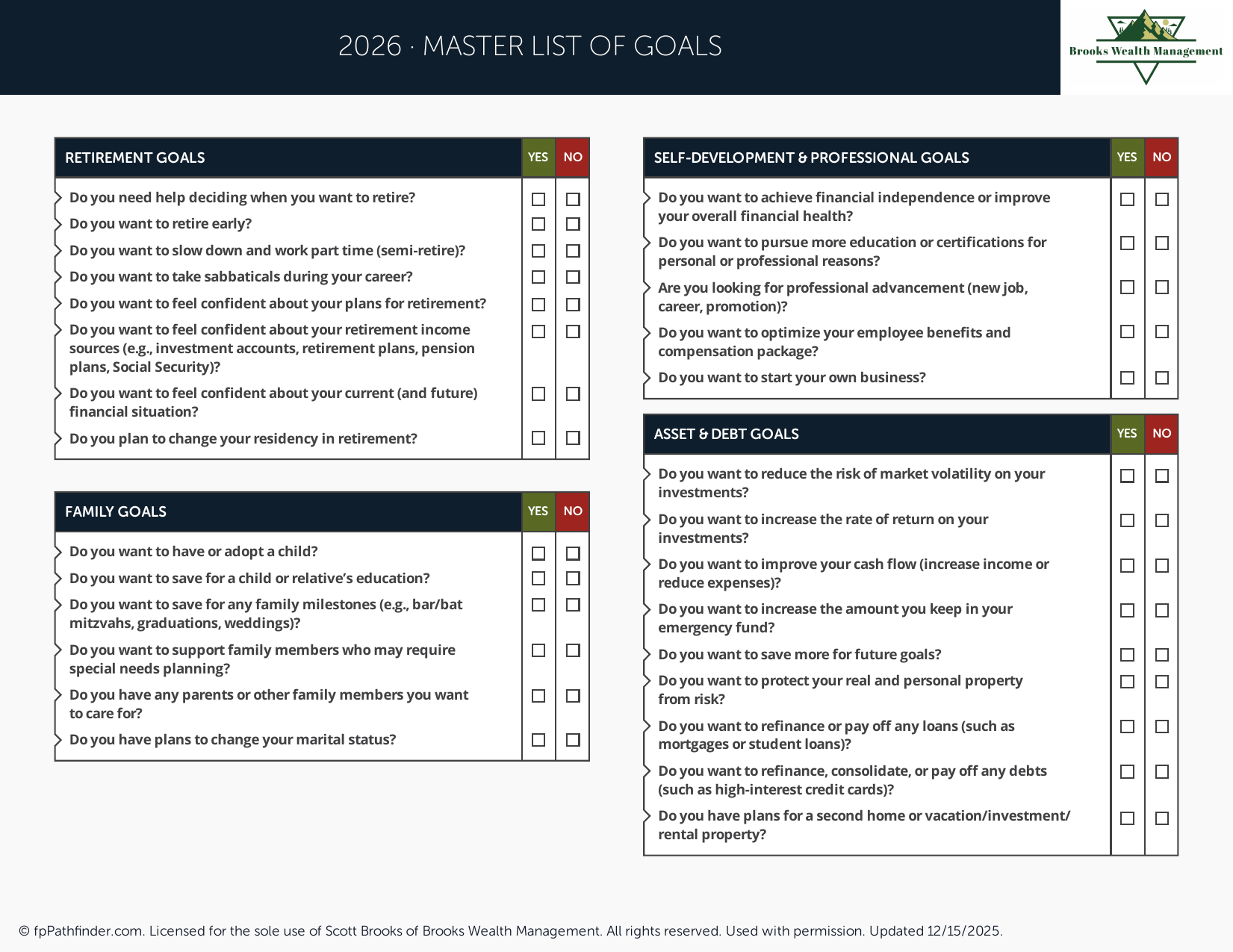
Comprehensive checklist of common financial goals to prioritize with your advisor.
- Building an emergency reserve
- Creating a sustainable spending plan
- Reducing high-interest debt
- Improving cash flow management
- Establishing automatic savings habits
- Maintaining appropriate insurance coverage
- Creating financial organization systems
- Advancing within a current career
- Changing professions
- Starting a business
- Growing an existing business
- Developing additional income sources
- Improving employee benefits utilization
- Increasing long-term earning capacity
- Building investment accounts
- Saving for future opportunities
- Creating financial flexibility
- Accumulating assets for long-term goals
- Maintaining a diversified investment portfolio
- Increasing tax-efficient savings
- Creating future passive income sources
- Achieving financial independence
- Creating retirement income sources
- Reducing dependence on employment income
- Managing retirement healthcare costs
- Determining an appropriate retirement age
- Building tax-efficient retirement assets
- Creating a sustainable withdrawal strategy
- Purchasing a home
- Relocating to a new area
- Starting or growing a family
- Funding childcare expenses
- Supporting aging parents
- Taking meaningful vacations
- Creating greater work-life balance
- Achieving geographic flexibility
- Funding future college expenses
- Supporting private education costs
- Saving for vocational or trade programs
- Funding graduate education
- Reducing future student loan needs
- Creating flexibility for future educational opportunities
- Improving tax-efficient savings habits
- Managing investment-related taxes
- Preparing for retirement tax considerations
- Coordinating business and personal tax planning
- Planning for major liquidity events
- Improving long-term after-tax outcomes
- Maintaining updated beneficiary designations
- Creating estate planning documents
- Protecting family members
- Facilitating efficient wealth transfer
- Supporting charitable causes
- Providing for future generations
- Clarifying personal wishes
- Travel and experiences
- Pursuing hobbies and passions
- Reducing financial stress
- Increasing personal flexibility
- Achieving greater life balance
- Supporting causes that matter to you
- Creating more time for family and relationships
What Financial Goals Should I Consider?
One of the most important parts of financial planning is identifying the goals that matter most to you. Investments, retirement accounts, insurance policies, tax strategies, and estate planning tools are all designed to support specific objectives. Without clearly defined goals, it can be difficult to prioritize financial decisions or determine whether progress is being made.
This checklist is designed to serve as a master list of common financial goals that individuals and families may consider throughout different stages of life. Not every goal will apply to every situation, and priorities often change over time. The purpose of this resource is to help you identify potential objectives, organize priorities, and create a framework for future planning discussions.
Review Foundational Financial Goals
Most financial plans begin with establishing a solid foundation. Before focusing on more advanced planning topics, many individuals prioritize goals that support financial stability and flexibility.
Examples may include:
These foundational goals often support many of the larger objectives that follow later in life.
Additional resources that may be helpful include Where Should My Next Dollar Go? and What Accounts Should I Consider If I Want to Save More?.
Review Career and Income Goals
Income is often the engine that powers a financial plan. As a result, many financial goals are connected directly or indirectly to career decisions and earning potential.
Potential goals may include:
Career-related decisions can influence nearly every other aspect of a financial plan, including retirement savings, taxes, investment opportunities, and lifestyle choices.
Review Savings and Investment Goals
Savings and investment goals often vary depending on age, family circumstances, and future objectives. Some goals may be relatively short-term, while others may span several decades.
Examples include:
Understanding the purpose behind savings and investment decisions can help guide account selection, asset allocation, and contribution priorities.
Review Retirement Planning Goals
Retirement planning is one of the most common long-term financial objectives. However, retirement means different things to different people. For some, it represents complete financial independence. For others, it may involve transitioning to part-time work, pursuing personal interests, or creating greater flexibility.
Retirement-related goals may include:
Related resources include What Issues Should I Consider Before I Retire?.
Review Family and Lifestyle Goals
Many financial goals are connected to family priorities and lifestyle decisions rather than purely financial outcomes. These goals often shape how resources are allocated throughout a lifetime.
Examples may include:
These goals frequently influence both short-term and long-term planning decisions.
Review Education Planning Goals
Education-related goals can apply to both children and adults. For some families, education planning becomes one of the largest financial objectives outside of retirement.
Goals may include:
Additional resources that may be helpful include How Should I Fund My Child's College Education?, Can I Make a 529-to-Roth Transfer?, and Is the Distribution From My 529 Plan Subject to Federal Income Tax?.
Review Tax Planning Goals
Taxes affect many aspects of financial planning. While tax considerations are generally only one part of a larger decision-making process, some individuals establish goals related to improving tax efficiency over time.
Examples include:
Tax planning goals often intersect with retirement, investments, charitable giving, and estate planning.
Review Estate and Legacy Goals
Estate planning goals often become increasingly important as wealth accumulates and family circumstances evolve.
Potential objectives may include:
Related resources include What Issues Should I Consider When Reviewing My Beneficiaries?.
Review Personal and Lifestyle Aspirations
Not every financial goal fits neatly into a traditional planning category. Some goals simply reflect the life you hope to build.
Examples may include:
Financial planning is ultimately about aligning financial resources with personal values and desired outcomes. Identifying meaningful goals can provide clarity and direction when making financial decisions.
About This Resource
This checklist was created to help individuals and families identify, organize, and prioritize common financial goals. The objective is to provide a structured framework for evaluating opportunities across savings, investing, retirement planning, education funding, tax planning, estate planning, family priorities, and lifestyle objectives.
Every person's goals are different. Priorities often change throughout life as careers evolve, families grow, financial resources increase, and new opportunities emerge. Periodically reviewing financial goals can help ensure that financial decisions remain aligned with current priorities and long-term objectives.
This resource is provided for educational purposes only and should not be construed as investment, tax, legal, or financial advice. Individuals should consult appropriate professionals regarding their specific circumstances before implementing any financial strategy.