
What Accounts Should I Consider If I Want to Save More?
Flowchart to identify the best account types for additional savings based on your situation.
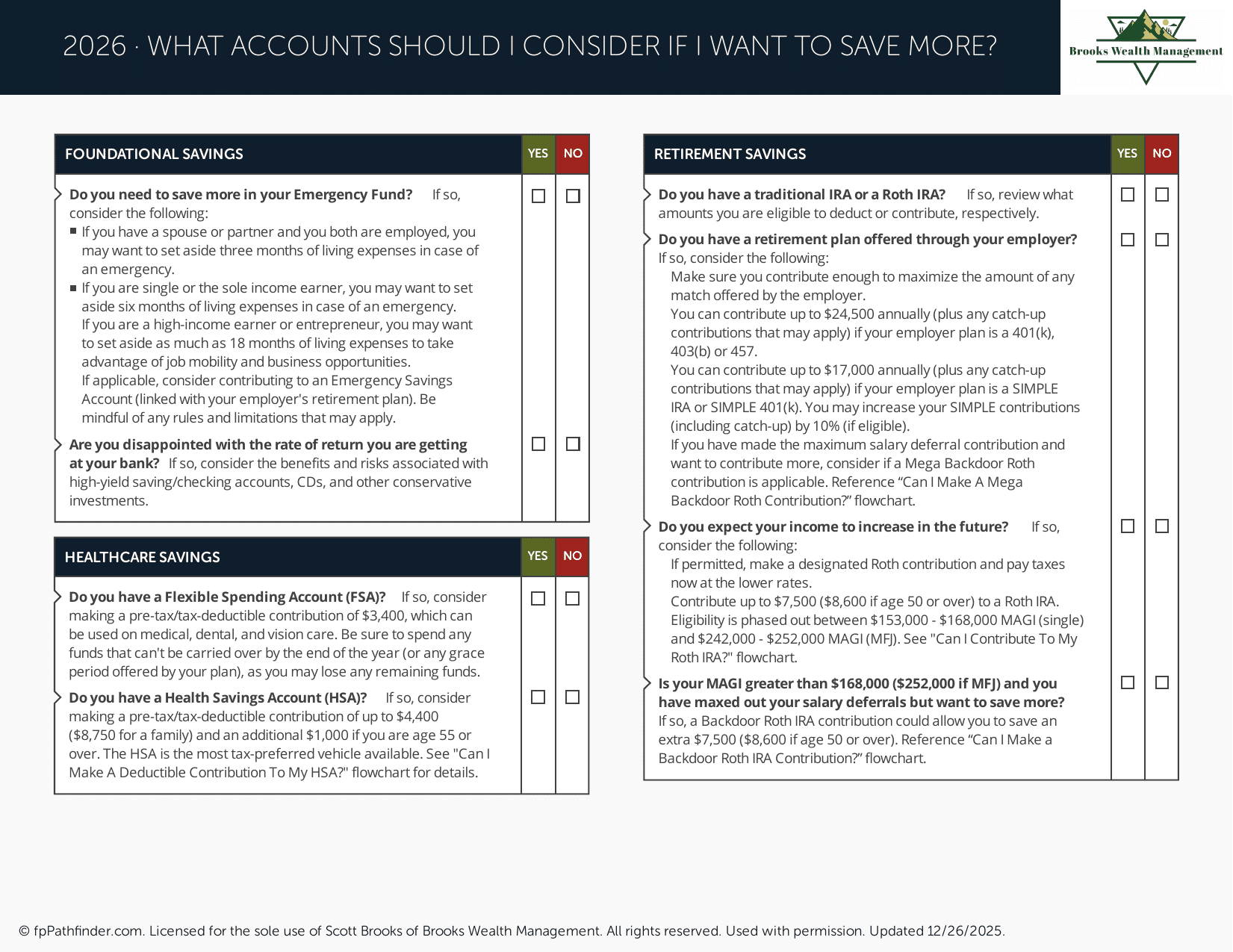
What Accounts Should I Consider If I Want to Save More?
Saving more is often one of the most common financial goals, but deciding where to save can be just as important as deciding how much to save. Different account types serve different purposes, and the most appropriate option often depends on your goals, time horizon, liquidity needs, tax considerations, and overall financial situation.
This checklist is designed to help individuals and families evaluate the types of accounts that may be worth considering when increasing savings. Rather than focusing on a specific product or strategy, the goal is to provide a framework for matching financial objectives with the account characteristics that may support those objectives.
Review Your Savings Goal First
Before selecting an account, it can be helpful to identify what the savings are intended to accomplish. Different goals often call for different approaches.
Questions worth considering include:
- Is the goal short-term or long-term?
- Will the funds be needed within the next few years?
- Is the objective retirement-related?
- Are you saving for education expenses?
- Do you need flexibility and immediate access to funds?
- Is tax efficiency a primary consideration?
Clarifying the purpose of the savings can often narrow the range of account types worth evaluating.
You may also find it helpful to review Where Should My Next Dollar Go? when determining how additional savings should be prioritized.
Review Cash and Emergency Reserve Accounts
For goals that require stability, liquidity, and easy access, cash-based accounts are often the starting point.
Examples may include:
- Savings accounts
- High-yield savings accounts
- Money market accounts
- Cash management accounts
- Certificates of deposit (CDs)
These accounts are commonly used for:
- Emergency reserves
- Near-term purchases
- Home down payment savings
- Upcoming tax obligations
- Business operating reserves
When evaluating these options, individuals often consider liquidity, safety, interest rates, and access to funds.
Review Employer Retirement Plans
Employer-sponsored retirement plans are often among the first accounts reviewed when increasing long-term savings.
Examples may include:
- 401(k) plans
- 403(b) plans
- 457 plans
- Other employer-sponsored retirement arrangements
Potential considerations include:
- Contribution opportunities
- Employer matching programs
- Investment options
- Tax treatment of contributions
- Withdrawal restrictions
For many individuals, workplace retirement plans play a central role in long-term retirement savings strategies.
Review Individual Retirement Accounts
Retirement savings opportunities may also extend beyond workplace plans. Individual retirement accounts can provide additional flexibility and may complement employer-sponsored retirement plans.
Examples include:
- Traditional IRAs
- Roth IRAs
- Spousal IRAs
Areas commonly reviewed include:
- Tax treatment of contributions
- Tax treatment of withdrawals
- Income-related eligibility considerations
- Investment flexibility
- Long-term retirement objectives
Related resources include Should I Consider Doing a Roth Conversion? and What Issues Should I Consider Before I Retire?.
Review Health Savings Accounts
Health Savings Accounts (HSAs) are often reviewed as part of a broader savings strategy when available through an eligible health plan.
Potential uses may include:
- Current healthcare expenses
- Future healthcare costs
- Long-term savings objectives
- Retirement healthcare planning
Because healthcare expenses can represent a significant future financial obligation, many individuals evaluate HSAs alongside other savings opportunities.
Review Taxable Investment Accounts
For goals that require flexibility and fewer restrictions, taxable investment accounts may be worth evaluating.
These accounts are often used for:
- Long-term wealth accumulation
- Early retirement planning
- Major future purchases
- General investing objectives
- Goals without specific tax-advantaged account limitations
Potential considerations include:
- Investment flexibility
- Tax implications
- Liquidity needs
- Risk tolerance
- Time horizon
Unlike many retirement accounts, taxable investment accounts generally provide greater access to funds, though different tax considerations may apply.
Review Education Savings Accounts
Individuals saving for future education expenses may evaluate specialized education-focused accounts as part of their planning process.
Examples may include:
- 529 plans
- Other education-related savings arrangements
Questions worth considering include:
- How much flexibility is desired?
- What are the expected education funding needs?
- How many years remain before funds may be needed?
- How does education planning fit within other financial priorities?
Additional resources include How Should I Fund My Child's College Education? and Can I Make a 529-to-Roth Transfer?.
Review Business and Self-Employed Savings Opportunities
Business owners and self-employed individuals may have access to additional savings opportunities that differ from those available to traditional employees.
Examples may include:
- SEP IRA arrangements
- Solo retirement plans
- SIMPLE retirement plans
- Business reserve accounts
- Other business-related savings structures
The appropriate solution often depends on business structure, profitability, employee considerations, and long-term planning objectives.
Review How New Savings Fit Within Your Overall Financial Plan
Saving more is generally most effective when it supports clearly defined goals. Rather than selecting accounts in isolation, many individuals benefit from evaluating how each account contributes to broader financial objectives.
Questions worth reviewing include:
- Which goals are highest priority?
- Are liquidity needs adequately addressed?
- Is retirement savings on track?
- Are education goals being funded appropriately?
- Does the savings strategy remain aligned with long-term plans?
Evaluating account selection within the context of an overall financial plan can help improve coordination between competing priorities and available resources.
You may also find value in reviewing Master List of Financial Goals and What Issues Should I Consider During a Cash Flow Review?.
About This Resource
This checklist was created to help individuals and families evaluate common account types that may be considered when increasing savings. The objective is to provide a structured framework for reviewing liquidity needs, retirement goals, education funding objectives, healthcare planning, tax considerations, and long-term financial priorities.
Every financial situation is unique. Factors such as income, tax circumstances, family needs, business ownership, investment objectives, and future goals can all influence which accounts may be appropriate to evaluate. Reviewing these issues carefully can help support informed savings decisions and long-term financial planning.
This resource is provided for educational purposes only and should not be construed as investment, tax, legal, or financial advice. Individuals should consult appropriate professionals regarding their specific circumstances before implementing any financial strategy.