
Common Trusts Summary Guide
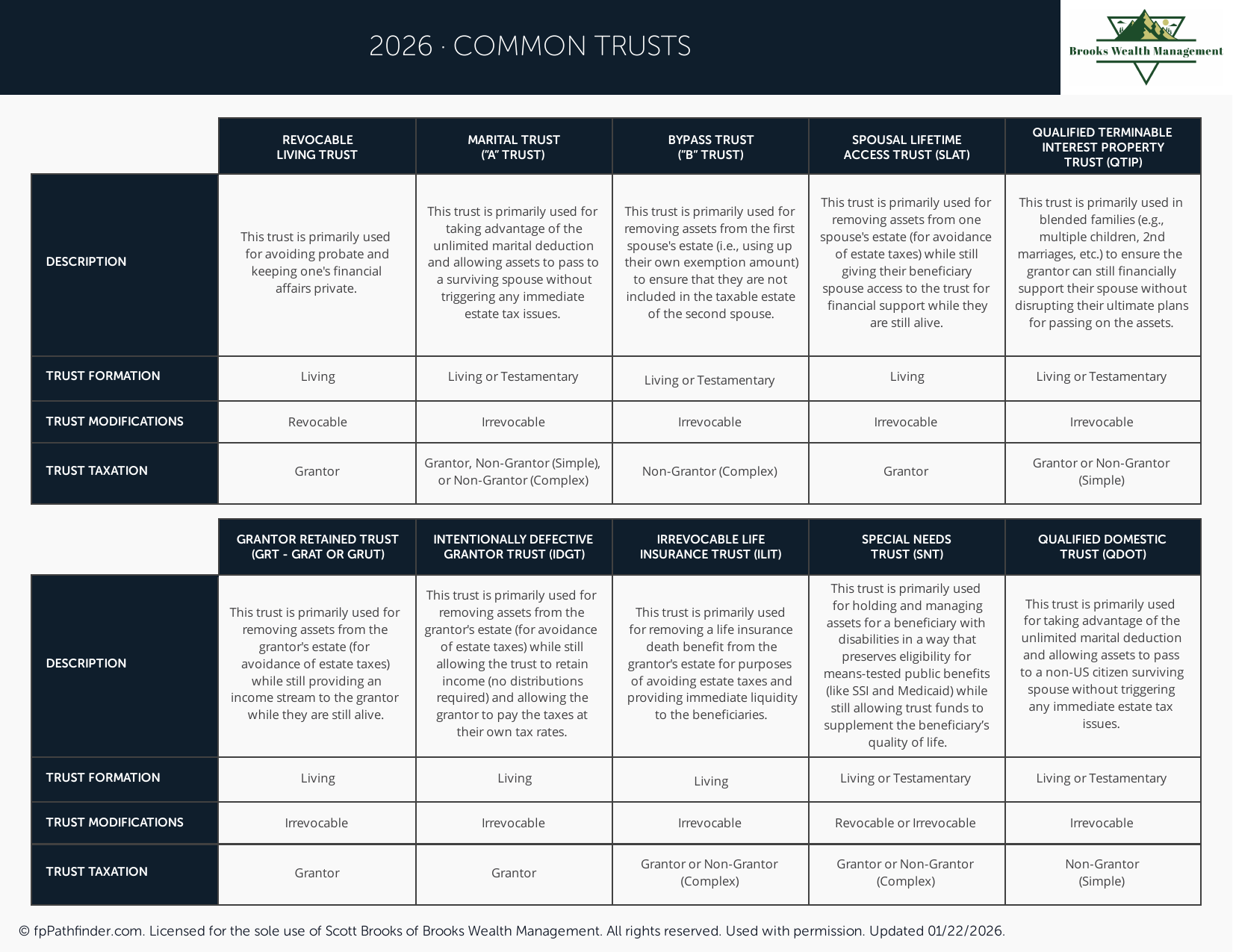
Reference guide summarizing common trust types, their purposes, and key features.
What Types of Trusts Should I Consider?
Trusts are among the most commonly discussed estate planning tools, but many people are unsure which type of trust may be appropriate for their situation. Different trusts are designed to address different goals, including asset management, beneficiary protection, charitable giving, incapacity planning, and estate administration.
Whether a trust is appropriate depends on your family circumstances, financial goals, asset structure, and estate planning objectives. Understanding the most common trust structures can help you have more informed conversations with your estate planning attorney and financial advisor.
Review Revocable Living Trusts
A revocable living trust is one of the most widely used estate planning tools. The individual creating the trust generally retains control of the assets and can amend, modify, or revoke the trust during their lifetime.
Common reasons individuals consider a revocable trust include:
- Managing assets during incapacity.
- Providing instructions for asset distribution.
- Creating continuity in financial management.
- Coordinating estate administration.
- Managing assets held in multiple states.
Because circumstances vary by state and family situation, individuals should discuss potential advantages and disadvantages with qualified legal counsel.
Review Irrevocable Trusts
Unlike revocable trusts, irrevocable trusts generally cannot be modified or terminated once established without satisfying specific legal requirements.
Irrevocable trusts are often used when planning objectives involve:
- Asset protection considerations.
- Life insurance planning.
- Business succession planning.
- Multi-generational wealth transfer.
- Charitable planning goals.
- Specialized estate planning strategies.
Because assets transferred to an irrevocable trust may no longer be under the direct control of the creator, these trusts typically require careful legal, tax, and financial review before implementation.
Review Special Needs Trusts
Special needs trusts are designed to help provide financial support for individuals with disabilities while coordinating with government benefit programs.
Families often review special needs trusts when considering:
- Long-term financial support.
- Care planning.
- Future caregiving arrangements.
- Inheritance planning.
- Benefit eligibility considerations.
Families evaluating these issues may also find value in reviewing What Issues Should I Consider for My Child with Special Needs?.
Review Charitable Trusts
Charitable trusts are often used by individuals and families who wish to incorporate philanthropy into their estate plan.
These trusts may be used to support charitable organizations while also addressing broader financial and estate planning objectives.
Questions worth considering include:
- Do charitable goals play a significant role in your financial plan?
- Would structured charitable giving be beneficial?
- Should future generations participate in charitable decisions?
- How does philanthropy fit into your estate planning goals?
Additional charitable planning resources include Should I Use a Donor-Advised Fund? and What Issues Should I Consider When Developing a Charitable Giving Strategy?.
Review Spendthrift Trusts
Some families establish trusts to provide structure around future distributions to beneficiaries.
A spendthrift trust may be considered when concerns exist regarding:
- Financial maturity.
- Creditor issues.
- Asset preservation.
- Long-term distribution control.
- Protection of inherited assets.
These trusts can provide instructions regarding how and when assets may be distributed according to the trust document.
Review Generation-Skipping Trusts
Generation-skipping trusts are designed to transfer assets to future generations under a structured framework.
Families may review generation-skipping trusts when considering:
- Multi-generational wealth planning.
- Family legacy goals.
- Long-term asset stewardship.
- Estate planning for future generations.
Because these trusts involve complex tax and estate planning rules, professional guidance is generally important when evaluating whether they fit within an overall estate plan.
Review Trusts for Minor Children
Parents frequently use trusts to manage inheritances for children and grandchildren.
Questions worth considering include:
- Who will manage inherited assets?
- When should distributions occur?
- Should funds be available for education or healthcare expenses?
- How should financial responsibility be introduced over time?
Families reviewing these issues may also find value in What Issues Should I Consider When Having or Adopting a Child?.
Review Whether a Trust Fits Your Overall Estate Plan
A trust is only one component of a comprehensive estate plan. Beneficiary designations, wills, powers of attorney, healthcare directives, account ownership, and tax planning should generally be reviewed together.
Questions worth discussing include:
- What goals are you trying to accomplish?
- Who should receive your assets?
- How should assets be distributed?
- Who will serve as trustee?
- How does a trust fit within your broader financial plan?
Individuals considering trusts may also find value in reviewing What Issues Should I Consider Before Creating an Estate Plan?, What Issues Should I Consider Before Updating My Estate Plan?, and What Issues Should I Consider When Reviewing My Beneficiaries?.
About This Resource
Financial planning works best when you have the right tools and frameworks to guide your decisions.
This resource was created to help you think through common trust structures in a clear, organized way. Trusts can play an important role in estate planning, beneficiary protection, charitable giving, incapacity planning, and wealth transfer, but the appropriate structure depends on your unique circumstances and objectives.
Scott Brooks, CFP® at Brooks Wealth Management uses resources like this with clients across Ventura County, Westlake Village, and throughout all 50 states to make complex financial topics easier to navigate. Review it, discuss it with your legal and tax professionals, and bring your questions to an introductory conversation.