
Will My Social Security Benefits Be Reduced?
Flowchart to determine whether your Social Security benefits will be reduced due to earnings, WEP, or GPO.
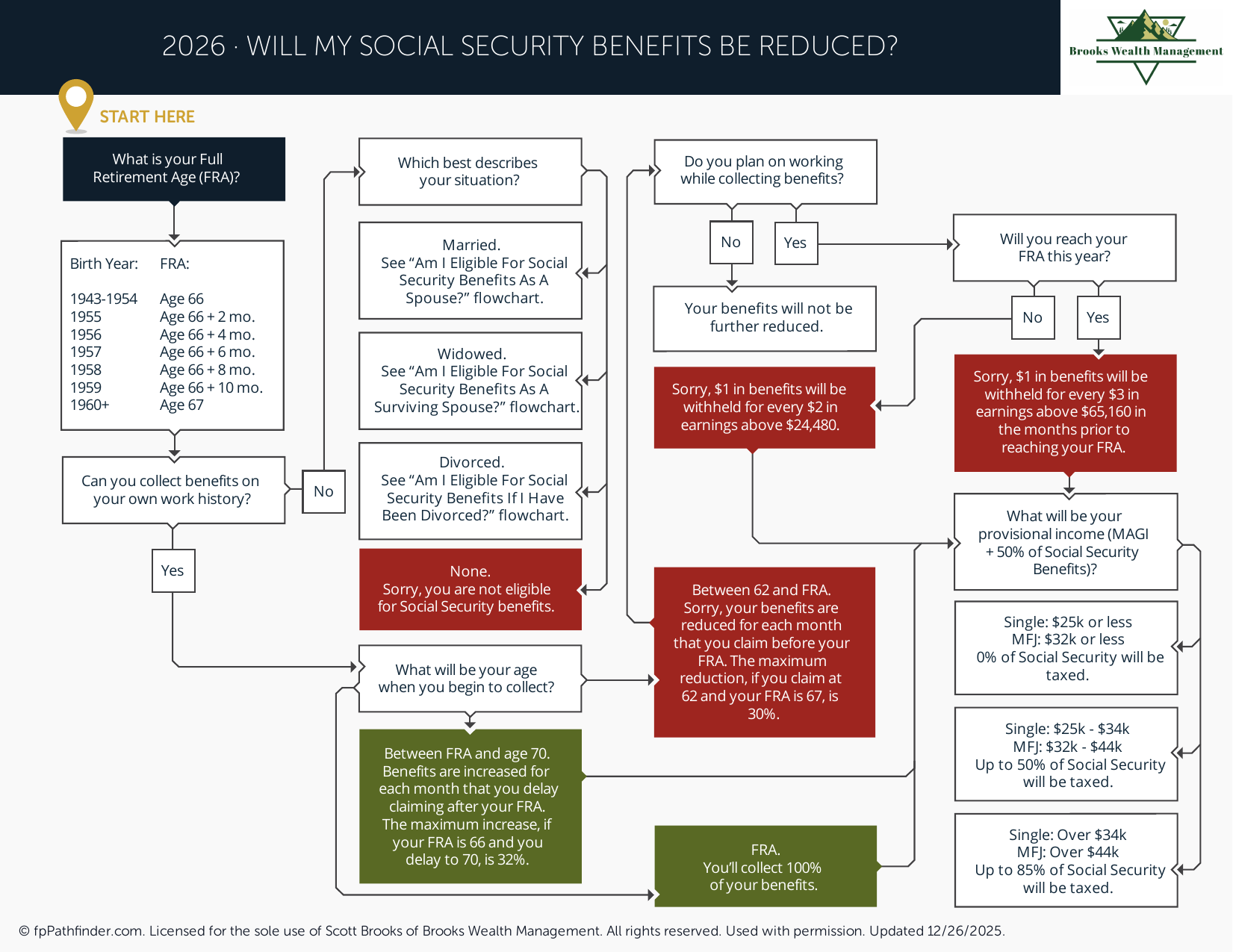
Will My Social Security Benefits Be Reduced?
Social Security benefits are an important source of retirement income for many individuals. As retirement approaches, people often review factors that could affect the amount of benefits they ultimately receive.
While future benefit amounts depend on individual circumstances and future legislation, there are several issues individuals commonly review when evaluating whether their Social Security benefits could be lower than expected.
Review Your Earnings History
Social Security retirement benefits are generally based on your highest 35 years of inflation-adjusted earnings. If you have fewer than 35 years of earnings on your record, years with no earnings are included in the calculation, which may reduce your benefit amount.
Many individuals review their Social Security earnings record periodically to confirm that reported earnings are accurate. Errors in earnings records can affect future benefit calculations if not corrected.
Additional information is available through our resource on Social Security retirement benefits.
Review Your Claiming Age
The age at which you begin receiving Social Security benefits can significantly affect your monthly benefit amount.
Benefits claimed before Full Retirement Age are generally reduced. Benefits claimed after Full Retirement Age may increase through delayed retirement credits until age 70.
Many retirees compare multiple claiming scenarios to better understand how claiming age affects both lifetime income and survivor benefits.
Review Employment Income Before Full Retirement Age
Individuals who claim Social Security benefits before reaching Full Retirement Age and continue working may be subject to Social Security's earnings test.
Under the earnings test, a portion of benefits may be temporarily withheld if employment income exceeds annual limits established by the Social Security Administration.
These reductions are generally temporary and may be reflected in future benefit calculations after Full Retirement Age is reached.
Review the Taxation of Social Security Benefits
Although Social Security benefits are not reduced directly, a portion of benefits may be subject to federal income taxation depending on overall income levels.
Individuals often review how retirement account withdrawals, pension income, investment income, and other sources of income may affect the taxation of Social Security benefits.
For some retirees, managing taxable income can become an important part of overall retirement planning.
Review Future Retirement Income Sources
Social Security is often one component of a broader retirement income plan. Individuals commonly review how Social Security benefits interact with:
- Retirement account withdrawals
- Pension income
- Investment income
- Annuity income
- Part-time employment income
- Required Minimum Distributions (RMDs)
Understanding how these income sources work together may help retirees evaluate overall retirement cash flow needs and tax considerations.
Review Legislative and Program Changes
Social Security rules have changed numerous times throughout the program's history, and future legislative changes remain possible.
Because future law changes cannot be predicted with certainty, many individuals periodically review retirement projections and maintain flexibility within their broader retirement plans.
Diversifying retirement income sources may help reduce reliance on any single source of retirement income.
Related Retirement Planning Resources
Individuals reviewing Social Security benefits often also review:
- Issues to consider before retirement
- Retirement withdrawal strategies
- Required Minimum Distributions (RMDs)
- Healthcare in retirement
About This Resource
This resource provides general educational information regarding Social Security retirement benefits. It is not intended as investment, tax, legal, or financial advice. Benefit calculations, eligibility rules, and future legislation may change over time.
If you would like to discuss Social Security claiming decisions, retirement income planning, or other retirement considerations, we invite you to schedule an introductory conversation.