
Will Healthcare Change as I Transition into Retirement?
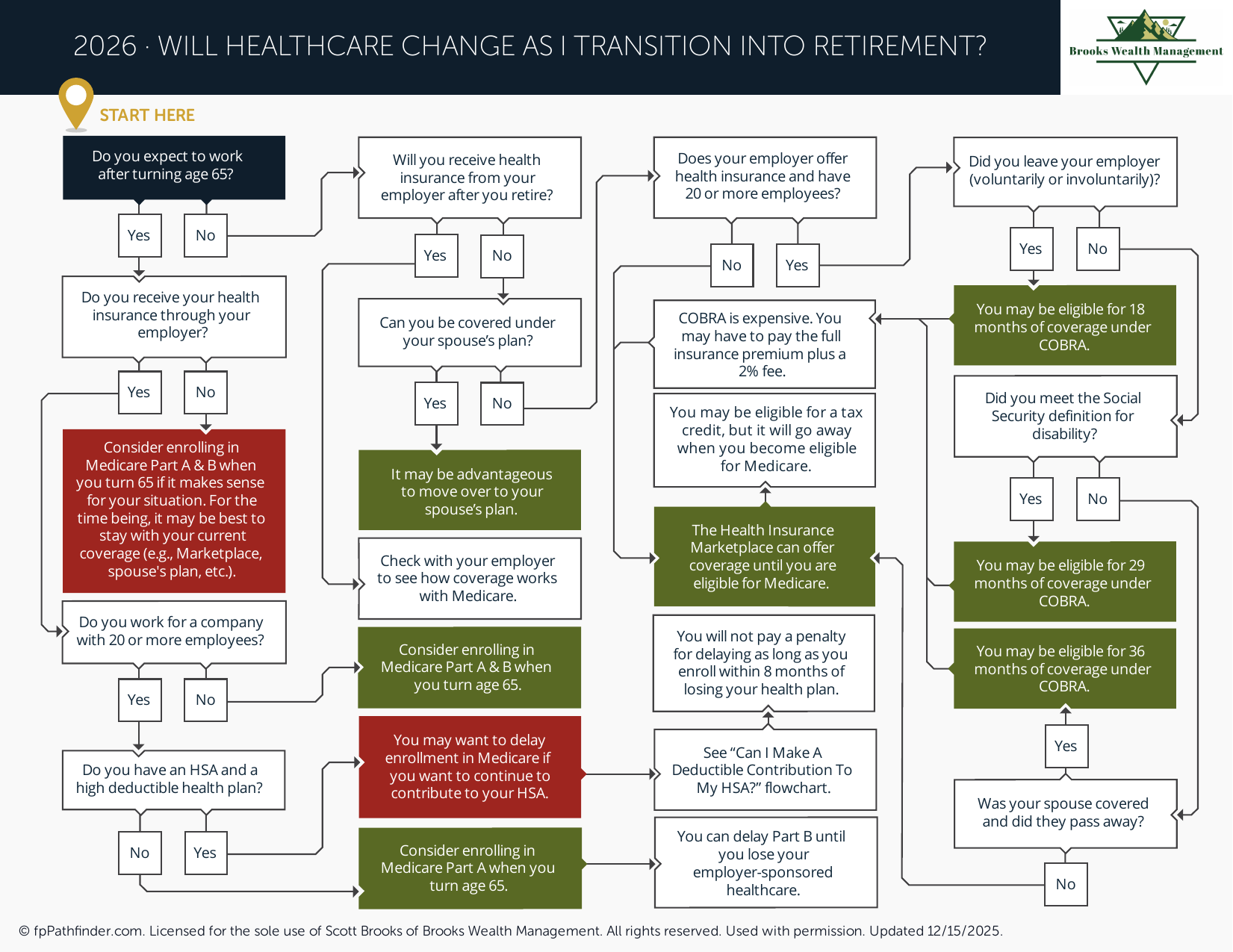
Flowchart covering healthcare coverage options and changes when transitioning from employer coverage to retirement.
Will Healthcare Change as I Transition Into Retirement?
For many people, healthcare becomes one of the most important planning considerations when approaching retirement. While retirement planning often focuses on investments, income sources, taxes, and spending, healthcare coverage can change significantly once employment ends. Understanding those changes before retirement can help reduce uncertainty and provide additional time to evaluate available options.
The transition from employer-sponsored healthcare to retirement coverage is rarely identical from one household to another. Factors such as age, retirement timing, Medicare eligibility, spousal coverage, employer benefits, and personal circumstances can all influence the available choices. This flowchart is designed to help organize those considerations and provide a framework for evaluating common healthcare decisions that may arise during retirement.
Why Healthcare Planning Deserves Early Attention
Many retirement decisions are interconnected. Healthcare choices may affect retirement timing, cash flow needs, tax planning considerations, and overall retirement readiness. For that reason, healthcare planning is often most effective when reviewed alongside other retirement planning topics rather than as a separate decision.
Individuals who leave the workforce before becoming eligible for Medicare may face different considerations than those who retire after Medicare eligibility begins. Others may have access to retiree healthcare benefits through an employer, while some households may rely on a spouse's coverage for a period of time. Understanding which path may apply to your situation can help make the transition more manageable.
If you are evaluating a broader retirement transition, you may also find it helpful to review What Issues Should I Consider Before I Retire? alongside this healthcare flowchart.
Review Potential Healthcare Coverage Changes
One of the most common retirement questions is what happens when employer-sponsored healthcare coverage ends. While the answer depends on individual circumstances, reviewing available options before retirement can help avoid last-minute decisions.
Depending on your situation, healthcare coverage during retirement may involve Medicare, retiree benefits, continuation coverage, private insurance, marketplace coverage, or other alternatives. The purpose of this flowchart is not to recommend a specific solution but rather to help identify the questions that may influence your decision-making process.
Individuals considering retirement before Medicare eligibility may also want to review If I Retire Early, Should I Buy Health Insurance Through the Health Insurance Marketplace? to better understand one potential coverage pathway.
Common Questions Retirees Review
As retirement approaches, many individuals find themselves asking similar healthcare-related questions:
- When will my current employer coverage end?
- Will I be eligible for Medicare when I retire?
- Does my spouse have coverage that could affect my options?
- What healthcare expenses should be included in retirement spending projections?
- Will prescription drug coverage change?
- Should supplemental insurance options be evaluated?
- Are there potential enrollment deadlines that should be monitored?
- How do healthcare decisions fit within my overall retirement plan?
While the answers vary by household, asking these questions early often leads to a more organized planning process. Resources such as this flowchart can help identify potential decision points before coverage changes occur.
Review Medicare Considerations
For many retirees, Medicare becomes a central component of healthcare planning. However, determining eligibility, understanding enrollment timing, and evaluating available coverage options can create confusion during the retirement transition.
Individuals approaching Medicare eligibility may benefit from reviewing additional educational resources, including Am I Eligible for Medicare Part A and Part B?, Will I Avoid Medicare Enrollment Penalties?, and Should I Change My Medicare Coverage During Open Enrollment?.
Higher-income retirees may also encounter Medicare premium adjustments based on income. For additional information, consider reviewing Will I Avoid IRMAA Surcharges on Medicare Part B and Part D?.
These resources are intended to provide educational context and can help build a broader understanding of healthcare planning considerations during retirement.
Healthcare Planning Is Part of a Larger Retirement Plan
Healthcare decisions do not occur in isolation. Coverage choices may influence spending needs, retirement income planning, cash reserve strategies, tax planning decisions, and overall retirement confidence. Reviewing healthcare planning alongside other retirement topics can help create a more complete picture of retirement readiness.
Many individuals find value in reviewing multiple planning resources together. In addition to healthcare-related flowcharts, you may wish to explore other retirement, tax, Social Security, and financial planning resources available in the Brooks Wealth Management Resource Library.
Using multiple educational tools can help identify questions that may deserve additional attention before major financial decisions are made.
How to Use This Flowchart
This healthcare retirement flowchart is intended to serve as an educational framework for reviewing common healthcare considerations during the retirement transition. It may be helpful before retirement, during the transition process, or as part of an ongoing retirement review.
The goal is not to provide a specific recommendation or predict future outcomes. Instead, the flowchart is designed to help organize information, identify potential decision points, and encourage thoughtful review of important healthcare planning topics.
Some individuals use resources like this independently, while others use them as discussion tools when meeting with financial professionals, insurance specialists, tax professionals, or other qualified advisors.
About This Resource
This flowchart was created as an educational resource to help individuals better understand healthcare coverage considerations that may arise when transitioning into retirement. The objective is to provide a structured review process that helps organize common questions and planning topics without assuming any particular course of action.
Because healthcare coverage options, retirement circumstances, and personal goals vary significantly, decisions should be evaluated based on individual facts and circumstances. Educational resources can help improve understanding, but they are not a substitute for personalized advice.
If you would like to discuss how healthcare planning fits into your broader financial situation, you can schedule an introductory conversation.