
What Issues Should I Consider When Reviewing My RMD?
Checklist of RMD calculation, timing, and planning considerations for retirement account owners.
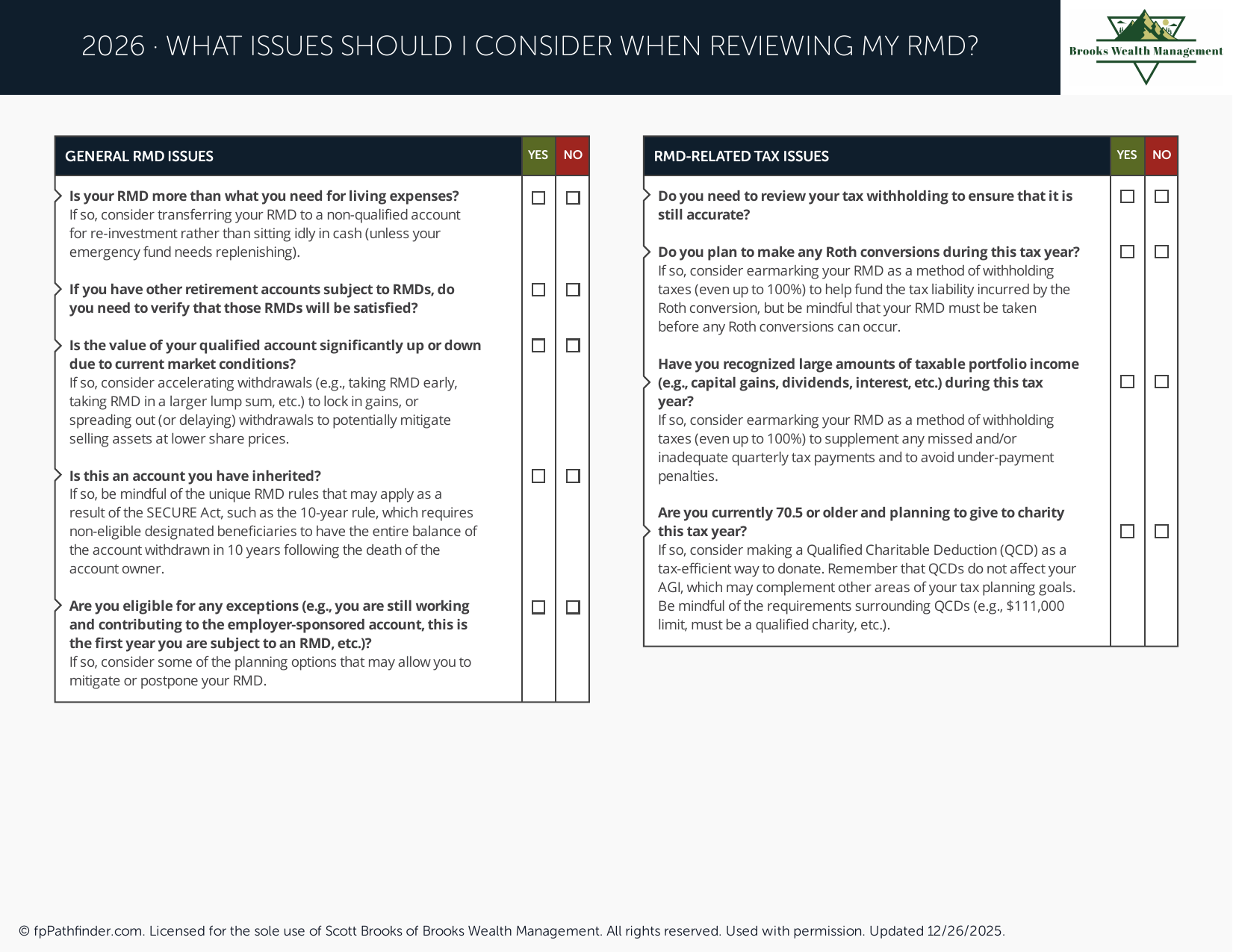
What Issues Should I Consider When Reviewing My Required Minimum Distribution (RMD)?
Once you reach the age at which Required Minimum Distributions (RMDs) begin, annual distribution decisions become an important part of retirement planning. Reviewing your RMD each year can help you understand how distributions affect taxes, retirement income, charitable giving strategies, and long-term financial planning.
This checklist highlights several common issues individuals review when evaluating their Required Minimum Distributions.
Confirm Your RMD Amount
Required Minimum Distributions are generally calculated using your retirement account balance as of December 31 of the previous year and an IRS life expectancy factor.
RMD rules typically apply to:
- Traditional IRAs
- SEP IRAs
- SIMPLE IRAs
- 401(k) plans
- 403(b) plans
- Most employer-sponsored retirement plans
Roth IRAs are generally not subject to Required Minimum Distributions during the original owner's lifetime.
Reviewing your calculated RMD amount each year can help avoid potential penalties for insufficient distributions.
Review Tax Implications of Your Distribution
RMDs are generally included in taxable income and may affect multiple areas of your financial plan.
Individuals often review how distributions may impact:
- Federal income taxes
- State income taxes
- Social Security taxation
- Medicare IRMAA surcharges
- Capital gains exposure
- Overall retirement income planning
Understanding how an RMD interacts with other income sources may help provide a clearer picture of total retirement income for the year.
Review Qualified Charitable Distribution (QCD) Opportunities
Individuals age 70½ and older may be eligible to make Qualified Charitable Distributions (QCDs) directly from an IRA to a qualified charity.
A QCD can count toward satisfying an RMD while potentially reducing taxable income because the distribution is generally excluded from adjusted gross income when completed properly.
For individuals who regularly support charitable organizations, reviewing QCD eligibility is often part of an annual RMD review.
Review Multiple Retirement Accounts
Many retirees maintain multiple retirement accounts accumulated throughout their careers.
Reviewing how RMD rules apply across accounts is important because distribution requirements vary by account type.
For example, certain IRA distributions may be aggregated, while employer-sponsored retirement plans often require separate calculations and distributions.
Understanding which accounts are subject to separate RMD requirements may help reduce administrative complexity and prevent mistakes.
Review Roth Conversion Opportunities
Although RMDs themselves cannot be converted to a Roth IRA, some retirees review whether future Roth conversions may help reduce future Required Minimum Distributions.
Potential considerations include:
- Current tax bracket
- Future projected tax rates
- Expected RMD growth
- Estate planning objectives
- Medicare premium considerations
For additional information, review our resource on Roth conversions.
Review Retirement Income and Withdrawal Strategy
RMDs represent only one component of retirement income planning.
Many retirees review how Required Minimum Distributions fit alongside:
- Social Security benefits
- Pension income
- Investment income
- Annuity income
- Taxable investment accounts
- Cash reserves
Evaluating all retirement income sources together may help individuals better understand their overall withdrawal strategy.
For additional guidance, visit our resource on retirement withdrawal strategies.
Review Estate Planning Considerations
Required Minimum Distributions may also affect estate planning objectives. Beneficiary designations, inherited retirement account rules, charitable planning strategies, and future tax obligations are commonly reviewed as part of a broader retirement planning process.
For additional information, visit our resource on estate planning reviews.
About This Resource
This resource provides general educational information regarding Required Minimum Distributions. It is not intended as investment, tax, legal, or financial advice. Individual circumstances vary and financial decisions should be evaluated based on personal goals and applicable laws.
If you would like to discuss your situation, we invite you to schedule an introductory conversation.