
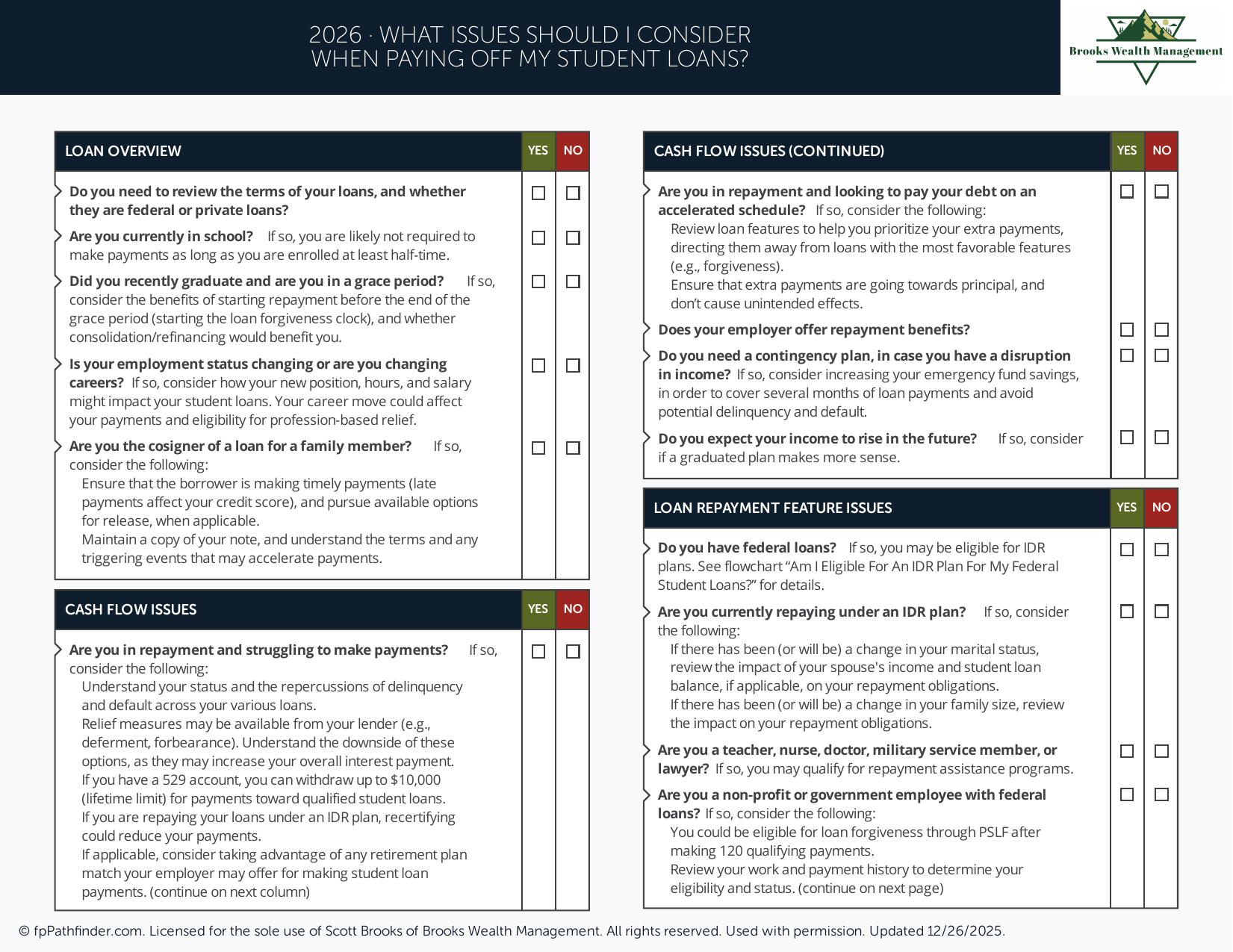
What Issues Should I Consider When Paying Off My Student Loans?
Checklist of key decisions and strategies when repaying or managing student loan debt.
What Issues Should I Consider When Funding My Child's College Education?
Funding a child's college education is a goal many families share, but the path toward that goal is rarely as simple as opening an account and making contributions. College planning often requires balancing multiple financial priorities at the same time, including retirement savings, emergency reserves, debt obligations, housing goals, and other family needs.
While education funding is important, it is typically most effective when viewed as one component of a broader financial plan. The purpose of this resource is to help you think through the major factors that can influence college funding decisions and identify the issues that may deserve additional review before committing significant resources to any particular strategy.
Review Your Overall Financial Priorities First
Before determining how much to save for college, it can be helpful to evaluate where education funding fits within your broader financial picture. Many households are simultaneously managing competing objectives, which may include:
- Building and maintaining emergency reserves
- Paying down high-interest debt
- Saving for retirement
- Purchasing a home or upgrading housing
- Planning for future healthcare expenses
- Funding children's education goals
College expenses can often be financed through a variety of methods, while retirement generally cannot. As a result, many families choose to evaluate retirement readiness alongside education planning rather than treating either objective in isolation.
You may also find it helpful to review Where Should My Next Dollar Go? and What Accounts Should I Consider If I Want to Save More? when determining how college savings fits into your overall savings strategy.
Review Your Expected Education Funding Goal
Not every family approaches college funding the same way. Some parents intend to cover the full cost of education, while others may plan to cover only a portion of expenses. Some families prioritize flexibility and simply want to build a dedicated education fund without targeting a specific amount.
Questions that may be worth considering include:
- Do you intend to fund all, some, or none of the expected education expenses?
- Will multiple children be involved?
- How many years remain before funds may be needed?
- Would private, public, in-state, or out-of-state schools affect your assumptions?
- Are grandparents or other family members planning to contribute?
- How important is flexibility if educational plans change?
The answers to these questions can significantly influence both account selection and the amount of savings that may be appropriate.
Review Available College Savings Vehicles
A variety of account types may be available for education planning. Each comes with its own rules, benefits, limitations, and tradeoffs.
Depending on your circumstances, considerations may include:
- Tax treatment of contributions and withdrawals
- Investment flexibility
- Control over assets
- Impact on financial aid calculations
- Ownership structure
- Beneficiary flexibility
- Administrative complexity
No single account type is automatically the best choice for every family. The appropriate option often depends on your goals, time horizon, tax situation, and desire for flexibility.
When evaluating account types, it can also be useful to review broader savings and investment considerations discussed in What Accounts Should I Consider If I Want to Save More?.
Review Tax and Financial Aid Considerations
Taxes and financial aid rules can influence the effectiveness of different education funding approaches. Depending on the account type being used, contributions, growth, distributions, ownership arrangements, and beneficiary designations may all create different outcomes.
Some areas that may warrant additional review include:
- Potential tax benefits associated with education savings accounts
- Qualified and non-qualified withdrawal rules
- Financial aid treatment of parent-owned and non-parent-owned assets
- Timing of distributions
- Coordination with scholarships, grants, and other assistance programs
- State-specific considerations that may apply
Because tax and financial aid rules can change over time, families may benefit from periodically reviewing their education funding strategy rather than assuming the original approach remains appropriate indefinitely.
Review Investment and Time Horizon Considerations
The length of time before funds may be needed can play a significant role in determining how college savings are invested. A child who is many years away from college may present different planning considerations than a student who expects to begin school in the near future.
As education approaches, some families review whether their investment allocation remains aligned with their expected withdrawal timeline and risk tolerance. This process often involves balancing growth objectives against the need to preserve capital for anticipated expenses.
Questions that may be helpful include:
- How soon will withdrawals likely begin?
- Will funds be needed over several years or all at once?
- Would a market decline materially affect the education plan?
- How much flexibility exists if investment performance differs from expectations?
Education planning is not solely a savings decision. It is also an investment planning decision that may evolve as college approaches.
Review Contingency Plans and Family Flexibility
One of the most overlooked aspects of college planning is preparing for outcomes that differ from the original expectation. Educational plans frequently change, and flexibility can be an important consideration when evaluating savings strategies.
Examples may include:
- A child chooses a different educational path
- Scholarships reduce the amount ultimately needed
- A student attends a lower-cost institution than expected
- Additional children require funding support
- Family financial circumstances change
- Retirement goals become a higher priority
Building flexibility into a college funding strategy may help families adapt to changing circumstances without significantly disrupting other financial goals.
You may also find it helpful to review What Issues Should I Consider When Reviewing My Beneficiaries? and What Issues Should I Consider Before I Retire? since education planning often intersects with broader estate and retirement planning decisions.
About This Resource
This flowchart is designed to help individuals and families evaluate the major considerations involved in funding a child's college education. The objective is not to recommend a particular strategy, account type, or course of action, but rather to provide a structured framework for thinking through the decisions that may influence an education funding plan.
Every family's circumstances are different. Factors such as income, savings capacity, retirement readiness, tax considerations, family size, educational goals, and investment preferences can all affect the appropriate approach. Reviewing these issues periodically can help ensure that education planning remains aligned with changing priorities and financial circumstances.
This resource is provided for educational purposes only and should not be construed as investment, tax, legal, or financial advice. Individuals should consult appropriate professionals regarding their specific circumstances before implementing any financial strategy.