
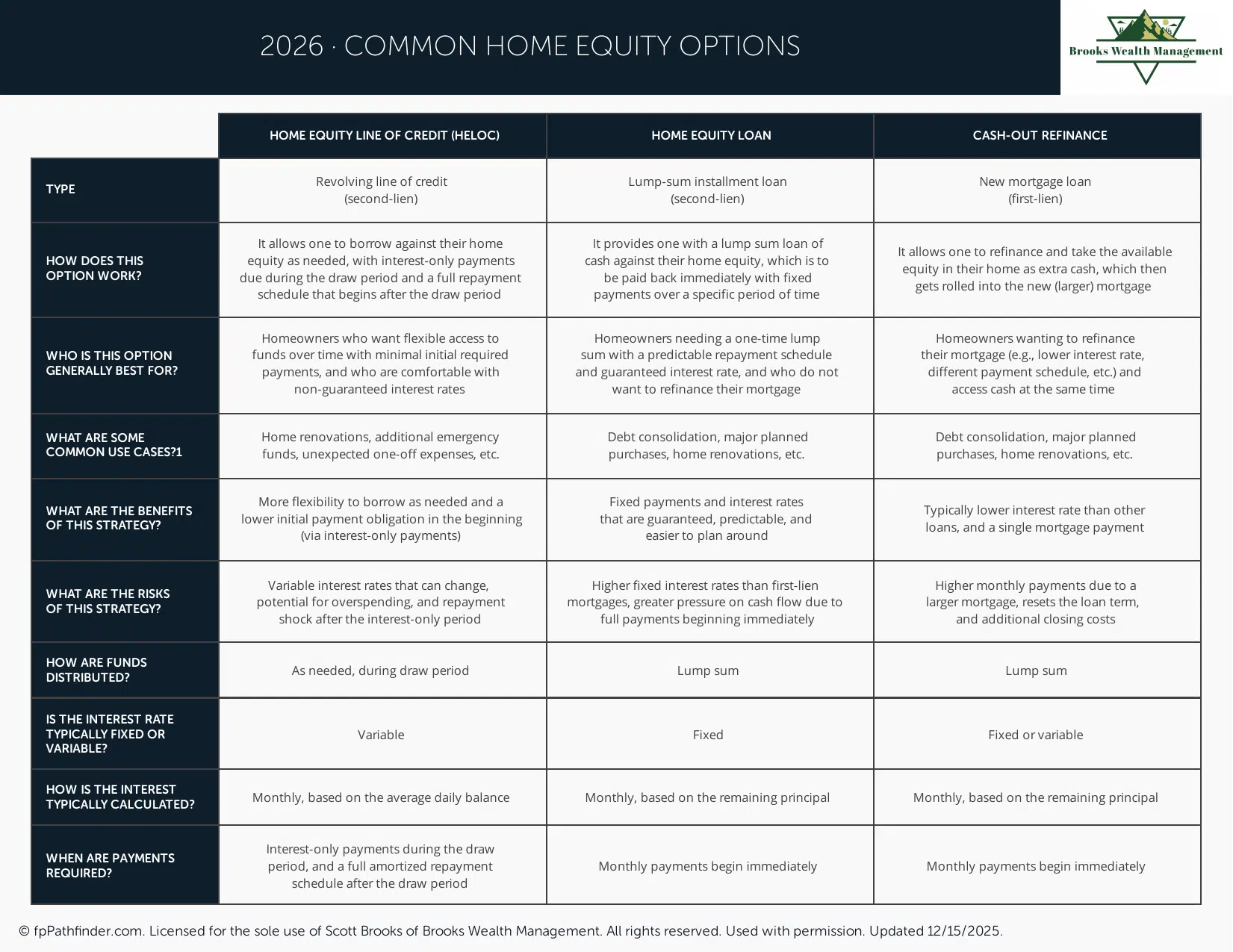
Common Home Equity Options
Reference guide comparing HELOC, home equity loan, and cash-out refinance options.
Should I Use a Donor Advised Fund When Giving to Public Charities?
Charitable giving can be an important component of a financial plan, allowing individuals and families to support causes they care about while incorporating philanthropy into broader financial, tax, and estate planning objectives. One charitable giving tool that is frequently evaluated is a donor advised fund (DAF).
This checklist is designed to help individuals and families review the issues that may be worth considering when deciding whether a donor advised fund may be appropriate for their charitable giving goals. While donor advised funds offer several potential benefits, they may not be the best fit for every situation.
Review Your Charitable Giving Objectives
Before evaluating any charitable giving vehicle, it can be helpful to clarify your overall goals.
Questions worth considering include:
- Which charitable organizations do you support?
- Do you give regularly or intermittently?
- Do you anticipate significant future charitable gifts?
- Are tax considerations an important factor?
- Would you like to involve family members in charitable decisions?
- Are charitable goals part of your long-term legacy planning?
Clearly defining charitable objectives can help determine whether a donor advised fund aligns with your broader intentions.
Review How a Donor Advised Fund Works
A donor advised fund is a charitable giving account sponsored by a public charity. Individuals contribute assets to the fund and may subsequently recommend grants to eligible charitable organizations over time.
Common characteristics of donor advised funds include:
- Irrevocable charitable contributions
- Administrative oversight by the sponsoring organization
- Potential investment of contributed assets
- Future grant recommendations to qualified charities
- Centralized charitable recordkeeping
Understanding the structure of a donor advised fund can help establish whether it may fit your charitable giving strategy.
Review Potential Tax Considerations
Tax considerations are often one reason individuals evaluate donor advised funds, although tax benefits should generally be considered within the context of broader charitable objectives.
Areas that may warrant review include:
- Timing of charitable deductions
- Charitable contribution limitations
- Income tax planning opportunities
- Contributions of appreciated assets
- Coordination with broader tax planning goals
Because individual tax circumstances vary, many donors evaluate these issues alongside qualified tax professionals.
Review Contributions of Appreciated Assets
Some individuals use donor advised funds when contributing assets other than cash. Depending on the sponsoring organization and asset type, various forms of property may be eligible for contribution.
Examples may include:
- Publicly traded securities
- Mutual funds
- Exchange-traded funds
- Certain business interests
- Other eligible assets accepted by the sponsoring organization
Reviewing available contribution options can help determine whether a donor advised fund may offer advantages relative to direct charitable gifts.
Review the Timing of Your Charitable Giving
Many donors prefer to make charitable contributions and charitable distributions at different times.
Questions worth considering include:
- Would you like flexibility regarding when charities receive funds?
- Do charitable giving amounts vary from year to year?
- Are there years with unusually high income?
- Would consolidating future charitable giving into one contribution be beneficial?
A donor advised fund may provide flexibility between the timing of a contribution and the timing of grants to charitable organizations.
Review Administrative Simplicity
For individuals supporting multiple organizations, charitable recordkeeping and administration can become more complex over time.
Potential considerations include:
- Tracking charitable contributions
- Maintaining donation records
- Coordinating grants to multiple charities
- Managing recurring charitable gifts
- Organizing tax documentation
Some individuals evaluate donor advised funds as a way to simplify charitable administration and reporting.
Review Family and Legacy Planning Goals
Charitable giving often extends beyond immediate donations. Some families use charitable planning as part of broader discussions regarding values, stewardship, and legacy.
Areas worth reviewing include:
- Involving children or grandchildren in charitable decisions
- Multi-generational charitable planning
- Long-term family philanthropy goals
- Charitable intentions within an estate plan
- Legacy planning objectives
Evaluating charitable giving within the context of family and estate planning can help ensure charitable goals remain aligned with broader objectives.
Related resources include What Issues Should I Consider Regarding Estate Management and Execution? and What Issues Should I Consider When Reviewing My Beneficiaries?.
Review Alternatives to a Donor Advised Fund
A donor advised fund is only one of several charitable giving options that may be available.
Other approaches that some individuals evaluate include:
- Direct charitable contributions
- Private foundations
- Charitable trusts
- Qualified charitable distributions where eligible
- Other charitable planning arrangements
The appropriate structure often depends on the size of anticipated gifts, desired complexity, administrative preferences, and long-term charitable goals.
Review Whether a Donor Advised Fund Fits Within Your Financial Plan
Charitable giving decisions are often most effective when coordinated with broader financial planning objectives.
Questions worth considering include:
- How does charitable giving fit within your financial goals?
- Are retirement goals adequately funded?
- How does charitable giving affect cash flow planning?
- Are there estate planning implications worth reviewing?
- Does the strategy align with your long-term priorities?
Evaluating charitable planning alongside investment, retirement, tax, and estate considerations can help provide a more complete perspective.
You may also find value in reviewing Master List of Financial Goals, What Accounts Should I Consider If I Want to Save More?, and What Issues Should I Consider Before I Retire?.
About This Resource
This checklist was created to help individuals and families evaluate common considerations associated with donor advised funds and charitable giving. The objective is to provide a structured framework for reviewing charitable goals, tax considerations, contribution strategies, administrative factors, family objectives, and long-term planning considerations.
Every charitable giving strategy is unique. Factors such as income, asset composition, tax circumstances, charitable priorities, family goals, and estate planning objectives can all influence whether a donor advised fund may be appropriate to evaluate further. Reviewing these issues carefully can help support informed charitable giving decisions.
This resource is provided for educational purposes only and should not be construed as investment, tax, legal, charitable, or financial advice. Individuals should consult appropriate professionals regarding their specific circumstances before implementing any charitable giving strategy.