
What Issues Should I Consider When Using a Reverse Mortgage?
Checklist of key considerations, risks, and benefits when evaluating a reverse mortgage.
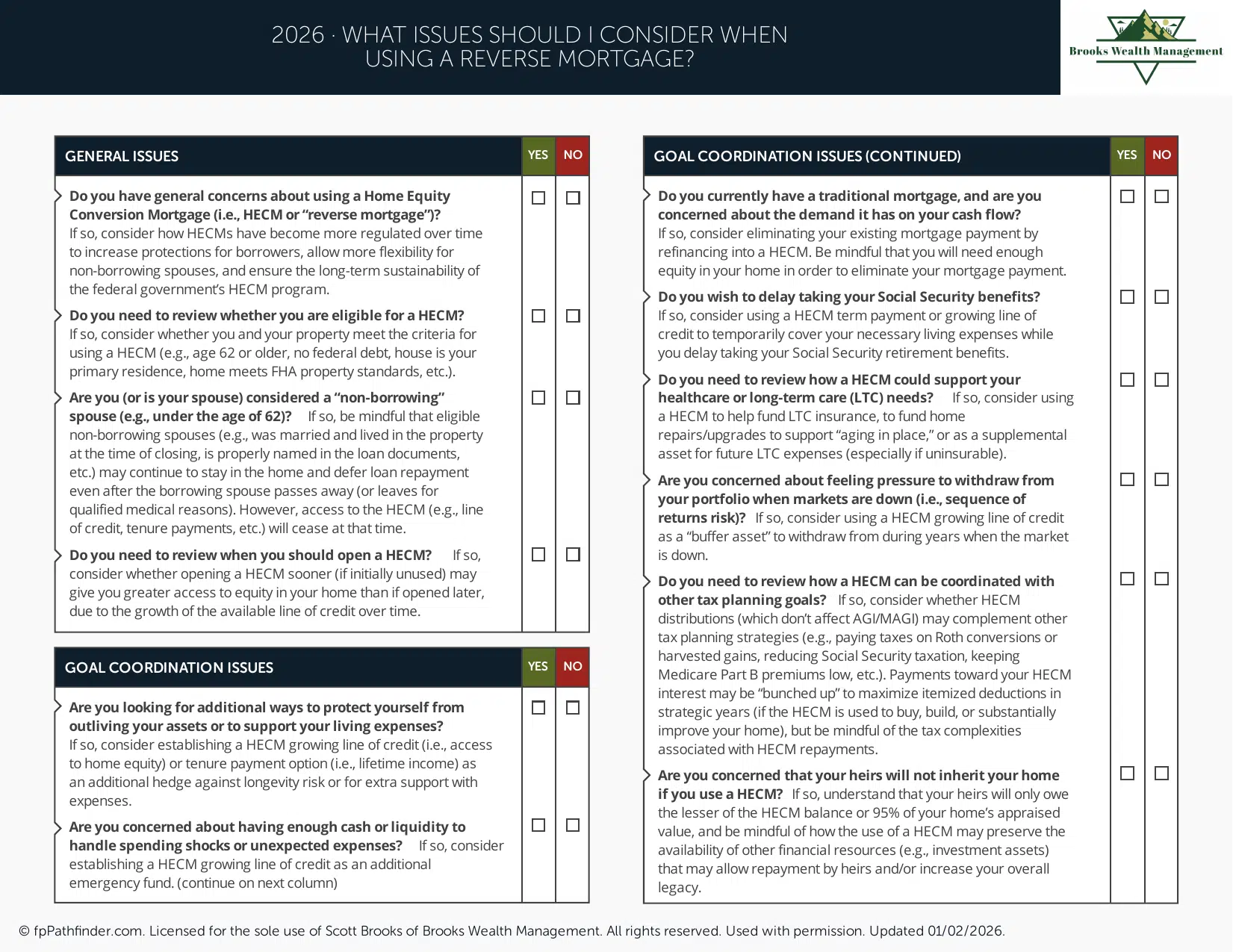
What Issues Should I Consider Before Getting a Reverse Mortgage?
A reverse mortgage is a financial tool that allows eligible homeowners to access a portion of their home equity without selling the property. While reverse mortgages can create additional flexibility for some retirees, they also involve important tradeoffs that should be carefully evaluated before moving forward.
This checklist is designed to help homeowners review the major issues that may affect a reverse mortgage decision. Because a reverse mortgage can influence retirement income, housing decisions, estate planning, and long-term financial flexibility, it is often most effective to evaluate the decision within the context of a broader financial plan rather than as a standalone transaction.
Review Why You Are Considering a Reverse Mortgage
Before evaluating loan terms, costs, or eligibility requirements, it can be helpful to understand the underlying reason a reverse mortgage is being considered. Different objectives may lead to different planning solutions.
Questions worth considering include:
- Is the goal to supplement retirement income?
- Is additional cash flow needed for living expenses?
- Are funds needed for healthcare or long-term care costs?
- Is the objective to improve financial flexibility?
- Are there concerns about investment account withdrawals during market declines?
- Is remaining in the current home a long-term priority?
Clearly identifying the purpose of the reverse mortgage can help determine whether it is the most appropriate option to evaluate.
You may also find it helpful to review What Issues Should I Consider Before I Retire? when evaluating retirement income sources and housing decisions.
Review Eligibility Requirements
Reverse mortgages are generally available only to homeowners who satisfy specific eligibility requirements. These requirements can vary depending on the program involved, property characteristics, and borrower circumstances.
Areas commonly reviewed include:
- Homeownership status
- Property eligibility
- Occupancy requirements
- Existing mortgage obligations
- Equity available within the home
- Financial assessment requirements
Understanding eligibility early in the process can help avoid unnecessary time spent evaluating options that may not be available.
Review Costs and Fees
One of the most important aspects of a reverse mortgage review is understanding the associated costs. Reverse mortgages often involve expenses that may be different from those associated with traditional mortgage products.
Potential costs may include:
- Origination fees
- Closing costs
- Mortgage insurance costs
- Servicing-related expenses
- Interest charges that accrue over time
- Other administrative fees
Evaluating the total cost of accessing home equity can help homeowners better understand how much value may ultimately be available and how the loan may affect future home equity.
Review the Long-Term Impact on Home Equity
Unlike a traditional mortgage where the loan balance may decline over time, reverse mortgage balances generally increase as interest and other charges accrue. As a result, home equity may decrease over time depending on future property values, loan activity, and the length of time the loan remains outstanding.
Questions worth reviewing include:
- How important is preserving home equity?
- Will home equity be needed for future financial goals?
- How might the loan affect future housing decisions?
- What role does the home play in the overall financial plan?
- How flexible are future plans if circumstances change?
Understanding these long-term implications can help homeowners evaluate the tradeoffs associated with accessing home equity today.
Review Ongoing Homeowner Responsibilities
A common misconception is that obtaining a reverse mortgage eliminates the financial responsibilities associated with homeownership. In reality, borrowers typically remain responsible for a variety of ongoing obligations.
These may include:
- Property taxes
- Homeowners insurance
- Required property maintenance
- Association dues where applicable
- Other property-related expenses
Failure to satisfy these obligations may create complications and could affect the status of the loan. As a result, many homeowners evaluate whether they will realistically be able to maintain these responsibilities throughout retirement.
Review the Impact on Heirs and Estate Planning
For many families, a reverse mortgage is not solely a retirement planning decision. It can also affect estate planning objectives and future wealth transfer considerations.
Topics that may warrant discussion include:
- The role of the home within the estate plan
- Expectations regarding inheritance
- Future housing plans for family members
- Liquidity needs of the estate
- Potential administrative responsibilities for heirs
Open communication can help ensure that family members understand how a reverse mortgage may affect future estate administration and property-related decisions.
Additional resources that may be helpful include What Issues Should I Consider When Reviewing My Beneficiaries?.
Review Alternative Strategies
Before moving forward with a reverse mortgage, many homeowners find it useful to evaluate alternative approaches that may address the same financial objective.
Potential alternatives may include:
- Downsizing to a different property
- Relocating to a lower-cost area
- Adjusting spending levels
- Using existing savings or investment assets
- Refinancing existing debt where appropriate
- Exploring other sources of liquidity
The appropriate solution depends on individual goals, resources, housing preferences, and overall financial circumstances.
You may also find value in reviewing Should I Consider Refinancing My Mortgage? and Should I Pay Off My Debts?.
Review How a Reverse Mortgage Fits Into Your Overall Financial Plan
A reverse mortgage is often most effective when evaluated as one piece of a broader financial planning strategy. Housing decisions, retirement income planning, tax considerations, investment management, and estate planning frequently interact with one another.
Questions worth considering include:
- How does the reverse mortgage affect retirement income needs?
- What role does home equity play within the overall balance sheet?
- How might future healthcare expenses influence the decision?
- Are there alternative assets available to support retirement goals?
- Does the strategy align with long-term family objectives?
A comprehensive review can help determine whether a reverse mortgage supports broader financial priorities rather than simply solving a short-term cash flow challenge.
About This Resource
This checklist was created to help homeowners evaluate common issues associated with reverse mortgages. The objective is to provide a structured framework for reviewing eligibility requirements, costs, home equity considerations, estate planning implications, homeowner responsibilities, and potential alternatives.
Every situation is unique. Factors such as retirement income needs, housing preferences, family circumstances, estate planning goals, health considerations, and available assets can all influence whether a reverse mortgage may be appropriate to evaluate further. Reviewing these issues carefully can help support more informed decision-making.
This resource is provided for educational purposes only and should not be construed as investment, tax, legal, mortgage, or financial advice. Individuals should consult appropriate professionals regarding their specific circumstances before implementing any financial strategy.