
What Issues Should I Consider When Purchasing Long-Term Care Insurance?
Checklist of key factors and questions to evaluate when shopping for long-term care insurance.
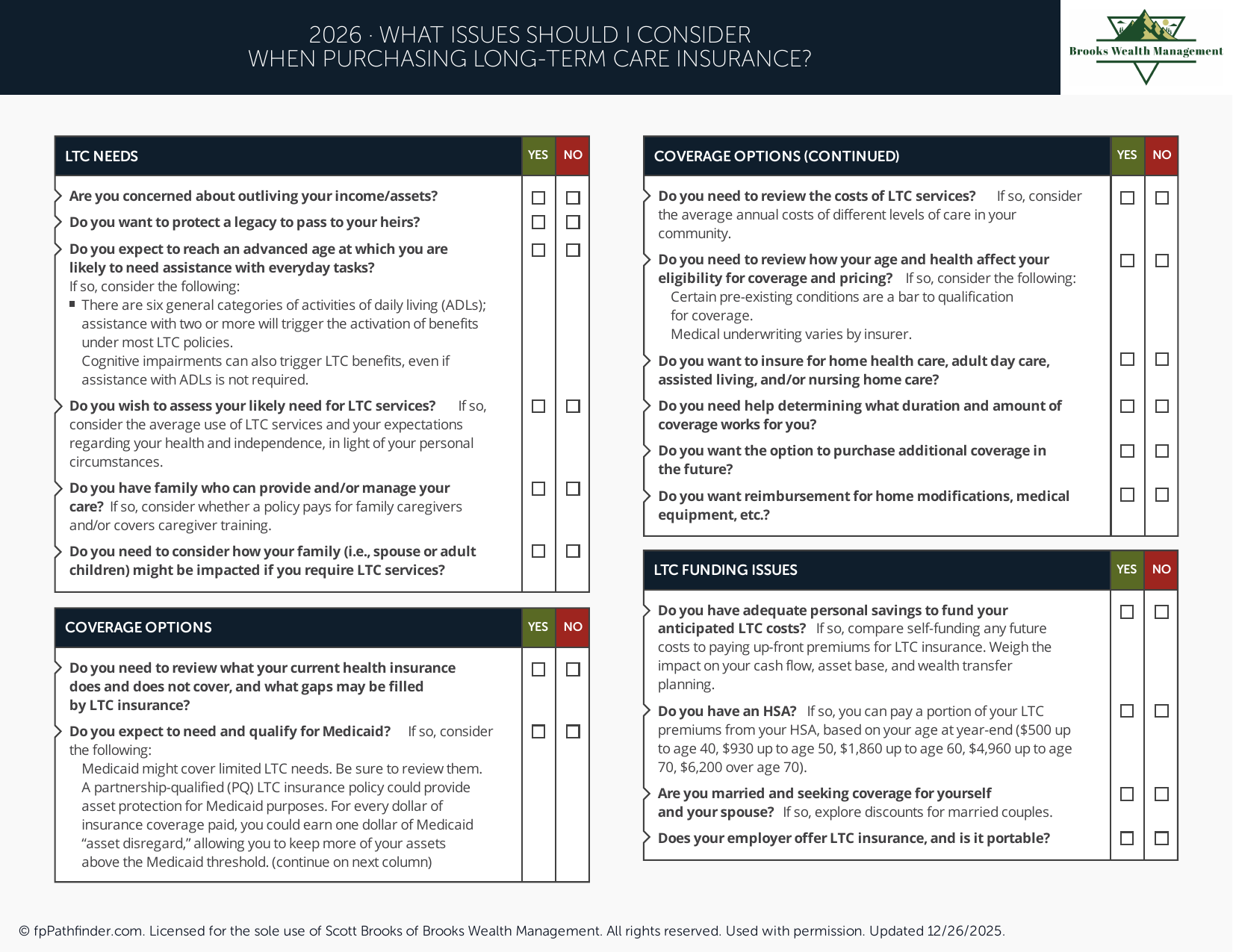
What Issues Should I Consider When Purchasing Long-Term Care Insurance?
Long-term care planning is a topic that many individuals eventually encounter as part of a broader retirement and financial planning process. While no one can predict future healthcare needs, some individuals choose to evaluate long-term care insurance as one potential tool for addressing expenses that may arise from extended care needs later in life.
This checklist is designed to provide a framework for reviewing common considerations when evaluating long-term care insurance. The objective is not to determine whether long-term care insurance is appropriate for any particular individual. Rather, it is intended to help organize questions and factors that may warrant consideration before purchasing coverage.
Review What Long-Term Care Insurance Is Intended to Cover
Long-term care insurance is generally designed to help address certain costs associated with extended care services that may not be fully covered by traditional health insurance programs. Depending on the policy and circumstances, coverage may apply to various types of care settings and services.
Before evaluating specific policies, many individuals find it helpful to understand the general purpose of long-term care insurance and how it differs from traditional health insurance, disability insurance, Medicare, or other forms of coverage.
Understanding what a policy is designed to cover—and what it may not cover—can provide important context when comparing available options.
Review Whether Long-Term Care Planning Fits Your Broader Financial Plan
Long-term care insurance is often evaluated within the context of retirement planning, healthcare planning, estate planning, and overall risk management. Because every household's financial situation is different, the role that long-term care insurance may play can vary significantly.
Some individuals evaluate long-term care insurance as part of a strategy to address potential future healthcare expenses. Others may consider self-funding potential costs, while some households may combine multiple planning approaches.
For those reviewing retirement-related healthcare considerations, it may also be helpful to review Will Healthcare Change as I Transition Into Retirement? and other retirement planning resources available in the Brooks Wealth Management Resource Library.
Review Coverage Features and Policy Design
Long-term care insurance policies can vary significantly in their structure and features. Before purchasing a policy, many individuals review key provisions to better understand how coverage may operate under different circumstances.
Questions that may be worth reviewing include:
- What services and care settings may be covered?
- How are benefits triggered?
- Are there elimination periods or waiting periods?
- How are benefit amounts determined?
- What limitations, exclusions, or restrictions apply?
- How long may benefits be available under the policy?
- Are inflation-related provisions available?
Because policy provisions can differ substantially between insurance carriers and policy designs, reviewing the details carefully may help improve understanding of available options.
Review Affordability and Ongoing Premium Commitments
Long-term care insurance is often evaluated not only based on coverage features but also on affordability over time. Individuals considering coverage may wish to review how premium obligations fit within their current budget and long-term financial plan.
Questions that may be worth considering include:
- Can current premium payments be comfortably maintained?
- How might retirement affect future affordability?
- How would changes in income affect the ability to maintain coverage?
- What role does the policy play within overall financial priorities?
Because long-term care planning may involve decisions that extend over many years, evaluating sustainability can be an important part of the review process.
Review Family, Health, and Personal Considerations
Personal circumstances often influence how individuals think about long-term care planning. Family support systems, healthcare history, caregiving preferences, retirement goals, and other factors may all contribute to the evaluation process.
While no checklist can account for every possible scenario, many individuals review questions such as:
- What caregiving resources may be available within the family?
- What are my preferences regarding future care arrangements?
- How might future healthcare needs affect retirement plans?
- Would extended care expenses have a meaningful impact on financial goals?
- How does long-term care planning fit within my broader estate planning objectives?
These considerations are highly personal and often extend beyond insurance alone.
Review Alternative Planning Approaches
Long-term care insurance represents one approach to addressing potential future care costs, but it is not the only approach that individuals may evaluate. Some households explore alternative strategies depending on their financial circumstances, assets, retirement goals, and risk tolerance.
Understanding available options may help provide context when evaluating whether long-term care insurance aligns with broader planning objectives.
Individuals reviewing healthcare and insurance planning topics may also find it useful to review What Issues Should I Consider When Reviewing My Health and Life Insurance Coverage? and What Issues Should I Consider When Purchasing a Life Insurance Policy?.
Review Long-Term Care Planning Alongside Retirement Planning
Long-term care planning is often most effective when considered alongside other retirement planning topics rather than as an isolated decision. Healthcare costs, retirement income sources, estate planning objectives, and cash flow considerations may all influence how individuals approach potential future care needs.
For this reason, some individuals incorporate long-term care discussions into broader retirement reviews. Additional resources that may be helpful include What Issues Should I Consider Before I Retire? and other retirement-focused educational resources available throughout the resource library.
How to Use This Checklist
This checklist is intended to serve as an educational resource that helps organize common considerations when evaluating long-term care insurance. It may be used as a starting point for personal research, periodic financial reviews, or discussions with qualified professionals.
The checklist does not provide recommendations regarding insurance carriers, policy structures, benefit levels, or planning strategies. Instead, it is designed to help individuals identify questions and planning considerations that may deserve additional review.
About This Resource
This checklist was created as an educational resource to help individuals better understand common considerations when evaluating long-term care insurance. The objective is to provide a structured framework for reviewing policy features, affordability considerations, healthcare planning topics, and broader retirement planning factors.
Because individual circumstances vary significantly, this resource should be used for educational purposes only and should not be interpreted as a recommendation regarding any insurance product, coverage election, or planning strategy.
If you have questions about how long-term care planning fits into your broader financial picture, you can schedule an introductory conversation.