
What Issues Should I Consider When Inheriting a Traditional or Roth IRA?
Checklist of key decisions and tax issues when inheriting a traditional or Roth IRA.
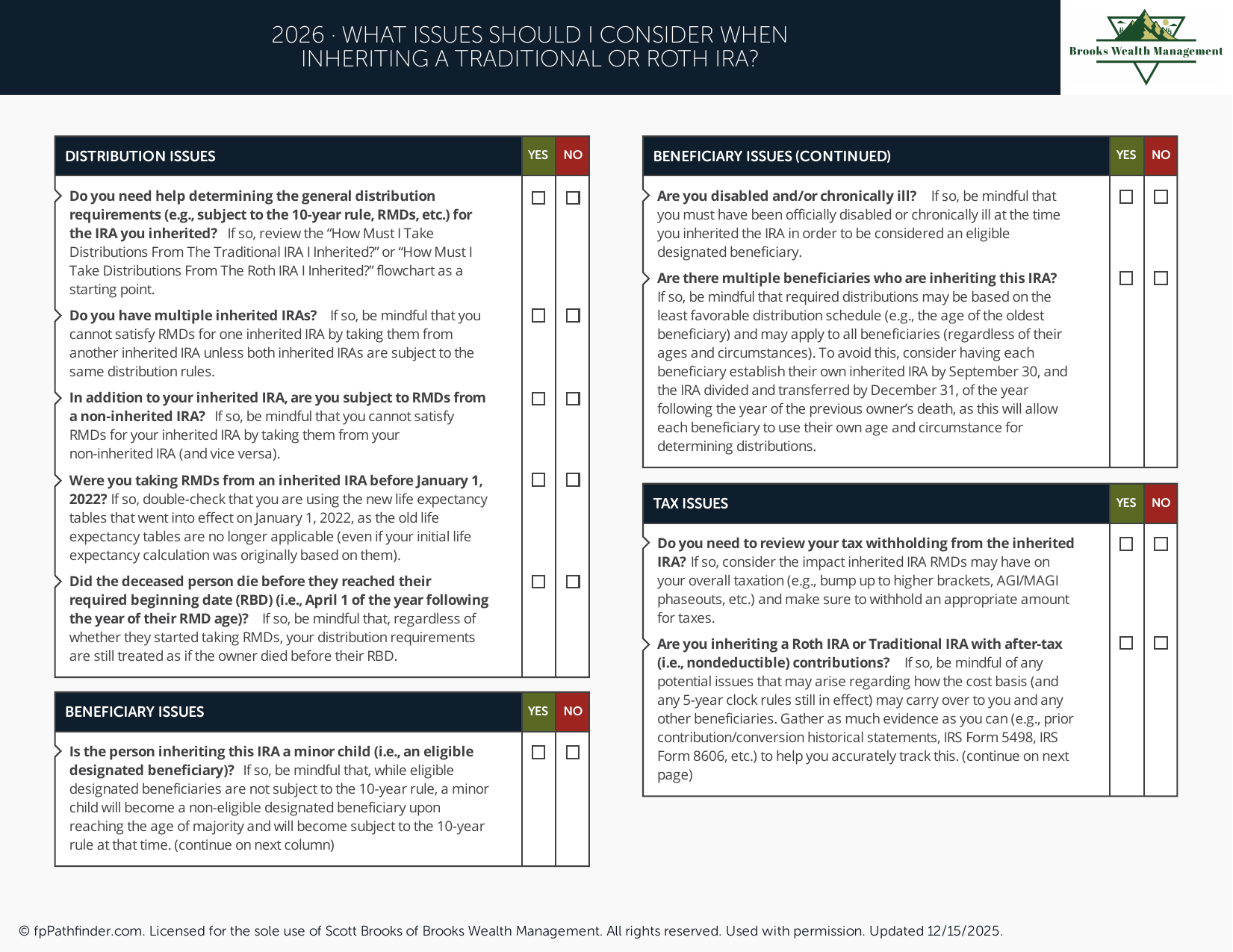
What Should I Consider If I Inherit an IRA?
Inheriting an IRA can create important financial planning decisions involving taxes, distributions, retirement planning, and wealth transfer considerations. The rules governing inherited IRAs differ depending on the type of IRA, the relationship between the beneficiary and the original account owner, and when the account owner passed away.
Because inherited IRA rules can be complex, individuals often review their beneficiary status, distribution requirements, tax consequences, and long-term planning objectives before making decisions regarding inherited retirement assets.
Review Your Beneficiary Status
The options available for an inherited IRA generally depend on the beneficiary's classification under IRS rules.
Common beneficiary categories include:
- Surviving spouses.
- Eligible designated beneficiaries.
- Non-spouse designated beneficiaries.
- Trusts and estates.
- Other entity beneficiaries.
Different distribution rules may apply depending on the beneficiary category, making this one of the first issues individuals often review after inheriting an IRA.
Review Spousal Beneficiary Options
Surviving spouses typically have the greatest flexibility when inheriting an IRA.
Common options that may be available include:
- Treating the IRA as their own.
- Rolling the assets into an existing IRA.
- Maintaining the account as an inherited IRA.
- Taking distributions based on applicable IRS rules.
Each option may affect future required minimum distributions, retirement planning, and tax considerations differently.
Individuals approaching retirement may also find it helpful to review issues to consider before retirement.
Review Non-Spouse Beneficiary Rules
Many non-spouse beneficiaries are subject to distribution requirements established under the SECURE Act.
Common considerations include:
- The applicable distribution period.
- Whether annual distributions may be required.
- The deadline for fully distributing inherited assets.
- The impact of distributions on taxable income.
- Coordination with broader tax planning objectives.
Because inherited IRA distribution rules may differ based on the circumstances of the original account owner and beneficiary, individuals often review these requirements carefully.
Review Eligible Designated Beneficiary Rules
Certain beneficiaries may qualify as eligible designated beneficiaries under IRS rules.
Examples may include:
- Surviving spouses.
- Certain minor children of the account owner.
- Certain disabled individuals.
- Certain chronically ill individuals.
- Individuals not more than ten years younger than the original account owner.
Special distribution rules may apply to eligible designated beneficiaries, which may affect long-term tax and retirement planning considerations.
Review Traditional and Roth Inherited IRA Differences
The tax treatment of an inherited IRA often depends on whether the account is a Traditional IRA or a Roth IRA.
Traditional Inherited IRA Considerations
- Distributions may generally be subject to ordinary income tax.
- Distribution timing may affect annual taxable income.
- Required distribution rules may apply.
- Tax planning opportunities may exist across multiple years.
Roth Inherited IRA Considerations
- Qualified distributions may generally be tax-free.
- Distribution requirements may still apply.
- Account age may affect tax treatment.
- Beneficiary distribution rules remain important.
Understanding the differences between Traditional and Roth inherited IRAs is often an important part of evaluating distribution strategies.
Review Required Minimum Distribution Rules
Required minimum distribution rules are among the most important issues affecting inherited IRAs.
Common considerations include:
- Whether annual distributions are required.
- The applicable distribution period.
- The age of the original account owner at death.
- The beneficiary's classification.
- Potential penalties for missed distributions.
Because distribution requirements can significantly affect tax outcomes, many beneficiaries review RMD rules before making withdrawal decisions.
Review Tax Planning Opportunities
Inherited IRA distributions may affect taxable income, tax brackets, deductions, credits, and other tax-related planning considerations.
Common questions individuals review include:
- Should distributions be spread across multiple years?
- How may distributions affect current tax brackets?
- Could large distributions create additional tax consequences?
- How do inherited IRA distributions interact with other income sources?
- Should Roth conversion opportunities be evaluated for other retirement assets?
Individuals interested in broader tax planning strategies may also find it helpful to review Roth conversion considerations.
Review Investment Considerations
Inheriting an IRA may create an opportunity to review the investments held within the account.
Common considerations include:
- Current asset allocation.
- Risk tolerance.
- Investment objectives.
- Time horizon.
- Coordination with existing investment accounts.
The investment strategy that was appropriate for the original account owner may not necessarily align with the beneficiary's circumstances and financial goals.
Review How an Inherited IRA Fits Within Your Financial Plan
An inherited IRA may affect retirement planning, tax planning, estate planning, and long-term financial goals.
Common questions individuals review include:
- How should distributions be coordinated with other income sources?
- What are the long-term tax implications of different distribution strategies?
- How does the inherited IRA affect retirement planning objectives?
- Should distributions be reinvested elsewhere?
- How does the inheritance affect overall financial priorities?
Because inherited IRA decisions often have long-term consequences, many individuals evaluate these choices within the context of a broader financial plan.
Additional savings and investment considerations can be found in our guide discussing what accounts to consider when saving more.
About This Resource
This resource provides general educational information regarding inherited IRAs, beneficiary rules, required minimum distributions, and tax considerations. The rules governing inherited retirement accounts can vary based on the type of IRA, beneficiary classification, and applicable federal regulations.
Individuals often review inherited IRA decisions when evaluating tax planning opportunities, retirement planning objectives, distribution requirements, investment strategies, and wealth transfer considerations. Understanding these rules may help beneficiaries make informed decisions regarding inherited retirement assets.
This resource is intended to provide a framework for understanding common inherited IRA considerations. It is not intended as investment, tax, legal, insurance, healthcare, cybersecurity, or financial advice. Individual circumstances vary, and applicable rules may change over time.
If you would like to discuss how this topic fits into your broader financial plan, we invite you to schedule an introductory conversation.