
What Issues Should I Consider If My Parent Passed Away?
Checklist of financial, legal, and administrative steps to take after the death of a parent.
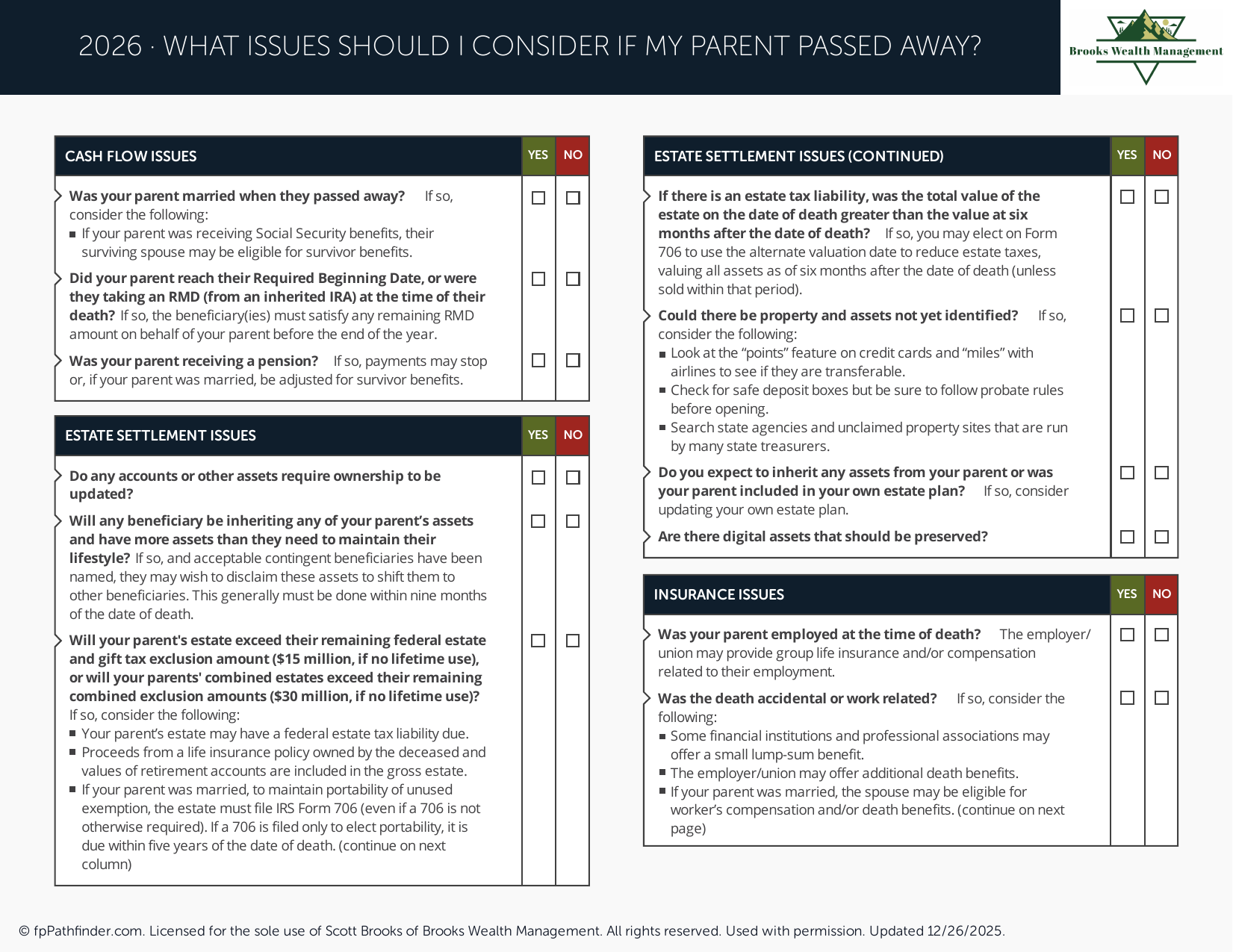
What Issues Should I Consider If My Parent Passed Away?
The death of a parent can be one of life's most difficult experiences. In addition to the emotional impact of a loss, surviving family members are often faced with a variety of financial, legal, administrative, and estate-related responsibilities that may require attention in the weeks and months ahead.
This checklist is designed to provide a framework for reviewing common issues that may arise following the death of a parent. The objective is not to provide legal, tax, estate planning, or financial advice, but rather to help organize important considerations and identify areas that may warrant additional review.
Review Immediate Administrative Responsibilities
Shortly after a parent's passing, there may be several administrative matters that require attention. While priorities vary depending on family circumstances, certain tasks are commonly encountered.
Items that may deserve review include:
- Obtaining certified copies of the death certificate.
- Locating wills, trusts, and estate planning documents.
- Identifying key financial accounts and assets.
- Contacting financial institutions as needed.
- Reviewing insurance policies.
- Notifying appropriate organizations and service providers.
Creating a centralized list of accounts, documents, and professional contacts may help simplify the process.
Review Estate Planning Documents
Estate planning documents often play an important role in determining how assets are managed and distributed following a death.
Documents that may deserve review include:
- Wills.
- Trust agreements.
- Powers of attorney.
- Healthcare directives.
- Beneficiary designations.
Because estate administration often involves legal considerations, many families choose to work with qualified legal professionals during the process.
Review Beneficiary Designations and Asset Transfers
Some assets may transfer according to beneficiary designations rather than instructions contained in a will. Understanding how various assets are titled can help provide clarity regarding the administration process.
Items that may deserve review include:
- Retirement accounts.
- Life insurance policies.
- Annuities.
- Transfer-on-death accounts.
- Payable-on-death accounts.
- Trust-owned assets.
A related resource that may be helpful is What Issues Should I Consider When Reviewing My Beneficiaries?.
Review Real Estate and Property Considerations
If a parent owned real estate or other significant property, there may be decisions regarding management, maintenance, ownership, or future disposition.
Questions that may be worth reviewing include:
- Who is responsible for ongoing property expenses?
- Does the property require maintenance or repairs?
- Are insurance policies current?
- Will the property be retained or sold?
- Are there mortgage obligations or other liabilities?
If property decisions become relevant, you may also find it helpful to review What Issues Should I Consider When Selling My Home?.
Review Life Insurance and Other Benefits
Depending on the circumstances, life insurance benefits or other financial resources may be available to beneficiaries.
Topics that may deserve review include:
- Individual life insurance policies.
- Employer-sponsored benefits.
- Pension-related benefits.
- Annuity contracts.
- Other contractual survivor benefits.
Understanding what benefits may exist can help support broader estate and financial planning discussions.
Review Retirement Accounts and Inherited Assets
Retirement accounts often require special attention because beneficiary rules and distribution options may differ from other types of assets.
Questions that may be worth reviewing include:
- What retirement accounts are involved?
- Who are the designated beneficiaries?
- What options are available regarding inherited accounts?
- How do inherited assets fit into the beneficiary's broader financial plan?
Because inherited retirement account rules can be complex, many individuals choose to seek professional guidance before making decisions.
Review Tax Considerations
The death of a parent may create tax-related considerations for the estate, beneficiaries, or both. While circumstances vary significantly, some individuals review:
- Final income tax returns.
- Estate administration tax requirements.
- Inherited investment accounts.
- Real estate-related tax considerations.
- Retirement account distributions.
Because tax consequences vary substantially based on individual circumstances, individuals often work with qualified tax professionals when evaluating these matters.
Review Family Communication and Decision-Making
Estate administration often involves communication among family members, beneficiaries, trustees, executors, or other interested parties.
Topics that may deserve consideration include:
- Roles and responsibilities.
- Document availability.
- Decision-making processes.
- Asset-related responsibilities.
- Ongoing communication needs.
Clear communication may help reduce confusion and support more efficient administration of the estate.
Review Your Own Financial and Estate Planning Documents
The death of a parent often serves as a reminder to review personal financial and estate planning documents.
Items that may deserve attention include:
- Your own beneficiary designations.
- Estate planning documents.
- Life insurance coverage.
- Retirement planning goals.
- Long-term financial objectives.
Related resources that may be helpful include:
- What Issues Should I Consider When Reviewing My Existing Life Insurance Policy?
- What Issues Should I Consider When Purchasing a Life Insurance Policy?
- What Issues Should I Consider Before I Retire?
Review How Inherited Assets Fit Into Your Financial Plan
For beneficiaries who inherit assets, it may be helpful to review how those assets fit within broader financial goals. While it may be tempting to make immediate decisions, some individuals prefer to take time before making major financial changes.
Questions that may be worth reviewing include:
- How do inherited assets affect overall net worth?
- Should long-term goals be revisited?
- Are there tax considerations that deserve review?
- How do inherited assets fit into existing investment and retirement plans?
- Are there family or estate-related obligations that remain outstanding?
A thoughtful review process may help ensure decisions remain aligned with long-term objectives.
Questions Worth Reviewing After the Death of a Parent
Many individuals find it helpful to review the following questions:
- Have important administrative responsibilities been addressed?
- Have estate planning documents been located and reviewed?
- Are beneficiary designations understood?
- Have insurance policies and benefits been evaluated?
- Do inherited assets require attention?
- Are there tax matters that deserve review?
- Have property-related issues been identified?
- How does this situation affect broader financial planning goals?
A structured review process may help organize important considerations during a difficult period and reduce the likelihood that key issues are overlooked.
How to Use This Checklist
This checklist is intended to serve as an educational resource that helps organize common financial, legal, administrative, and estate-related considerations following the death of a parent. It may be useful for beneficiaries, executors, trustees, and family members involved in estate administration.
The checklist does not provide legal, tax, estate planning, investment, or financial advice. Instead, it is designed to help identify planning topics and questions that may warrant additional review.
About This Resource
This checklist was created as an educational resource to help individuals better understand common financial, legal, and administrative considerations that may arise following the death of a parent. The objective is to provide a framework for organizing estate-related responsibilities, reviewing inherited assets, and understanding how a loss may affect broader financial planning considerations.
Because family circumstances, estate matters, tax considerations, and financial situations vary significantly, this resource should be used for educational purposes only and should not be interpreted as legal, tax, estate planning, investment, or financial advice.
For additional planning resources, visit the Brooks Wealth Management Resource Library. If you have questions about how inherited assets or estate matters may affect your broader financial picture, you can schedule an introductory conversation.