
What Issues Should I Consider If I Get a Promotion or Raise at Work?
Checklist of tax, savings, and benefit adjustments to consider after receiving a raise or promotion.
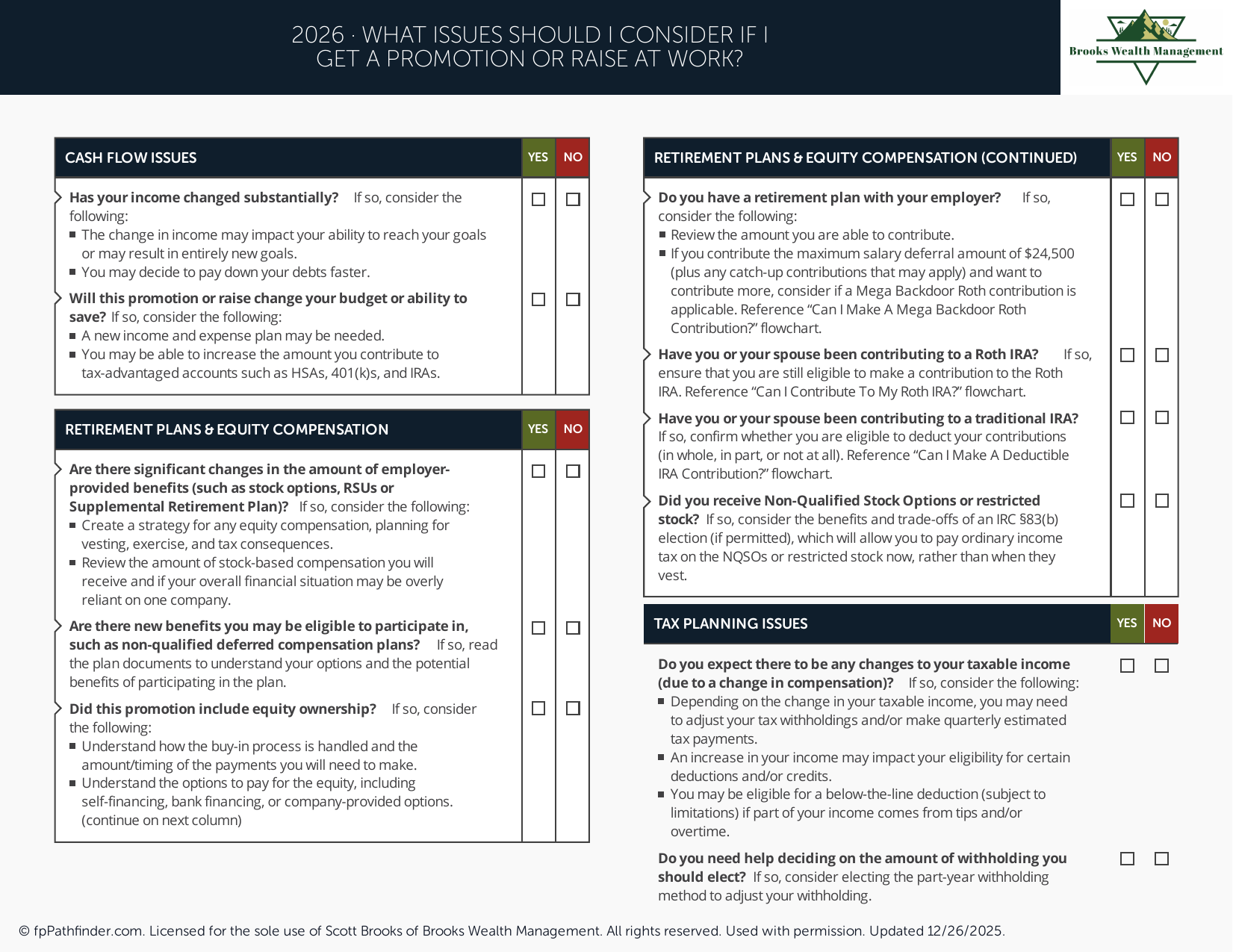
Raise or Promotion: What to Do With the Extra Income
A raise or promotion can create an opportunity to strengthen your financial position, but it can also lead to higher spending if additional income is absorbed into day-to-day expenses. Taking time to evaluate your options before adjusting your lifestyle may help you make more intentional decisions about how additional income fits into your broader financial plan.
This guide highlights several financial considerations that may be worth reviewing after a raise or promotion. Every situation is different, and the appropriate course of action will depend on your income, goals, tax situation, benefits, and overall financial circumstances.
Review Your Tax Withholding After a Raise or Promotion
A raise or promotion may affect your tax situation, particularly if your compensation now includes bonuses, commissions, equity compensation, deferred compensation, or other sources of income. In some cases, withholding may no longer accurately reflect your expected tax liability for the year.
Reviewing your Form W-4 and estimated tax payments may help reduce the likelihood of underpayment or unexpected tax balances. This can be especially important for individuals receiving bonuses, restricted stock units (RSUs), stock options, or other forms of supplemental compensation that may be subject to withholding rates different from their marginal tax rate.
Evaluate Retirement Savings Opportunities
A raise or promotion may also provide an opportunity to revisit retirement savings goals. Some individuals choose to increase their 401(k), 403(b), or other retirement plan contributions when compensation increases because it allows them to increase savings without experiencing as much impact on their take-home pay.
If you are not currently maximizing available retirement plan contributions, a compensation increase may be an appropriate time to review your savings strategy. It may also be worthwhile to evaluate whether Roth or pre-tax retirement contributions align better with your current income level and long-term goals. For additional information, see our guide on Roth 401(k) versus traditional 401(k) contributions.
Review Changes to Employee Benefits
A raise or promotion may come with changes to your overall compensation package, including bonus opportunities, equity compensation, deferred compensation plans, retirement benefits, insurance coverage, or other employer-sponsored programs. Understanding how these benefits work may help you make more informed financial decisions.
Some benefits, including deferred compensation plans and certain equity programs, may require elections to be made within a specific timeframe. Reviewing available options before deadlines occur can help ensure opportunities are not overlooked.
Consider Your Cash Flow Priorities
Additional income can be directed toward a variety of financial goals, including emergency savings, debt reduction, retirement contributions, investment accounts, education funding, charitable giving, or future major purchases. Determining where additional dollars fit within your overall financial plan may help align spending and saving decisions with your long-term objectives.
For a broader framework on prioritizing additional income, see our resource on where your next dollar should go. You may also find our guide on reviewing cash flow helpful. Both resources are available in our free resource library.
Align Spending Decisions With Long-Term Goals
A raise or promotion may create opportunities to increase spending, but it may also create opportunities to improve long-term financial flexibility. Before making significant financial commitments, such as purchasing a home, upgrading vehicles, or increasing recurring expenses, it can be helpful to evaluate how those decisions fit into your overall financial plan.
Reviewing major spending decisions within the context of your long-term goals may help ensure that additional income supports both current priorities and future objectives.
About This Resource
This resource provides general educational information regarding financial considerations that may arise following a raise or promotion, including taxes, retirement savings, employee benefits, cash flow, and long-term planning decisions. Every individual's circumstances are different, and financial strategies should be evaluated based on personal goals, income, tax considerations, and available benefits.
Brooks Wealth Management works with professionals, business owners, retirees, and families on a wide range of financial planning topics. If you would like to discuss your situation, we invite you to schedule an introductory conversation or learn more about our approach on our pricing page.
Have Questions About Your Situation?
This resource is intended for educational purposes only. If you would like to discuss your circumstances, schedule an introductory conversation with Scott Brooks, CFP®.
Schedule an Introductory ConversationVentura County, California · Serving Clients Throughout California and Across the United States
Brooks Wealth Management is a Registered Investment Adviser registered with the State of California. Registration does not imply a certain level of skill or training. This content is provided for informational and educational purposes only and should not be construed as investment, tax, legal, or accounting advice. Advisory services are offered only to clients or prospective clients where Brooks Wealth Management and its representatives are properly licensed or exempt from licensure. Investing involves risk, including the potential loss of principal. CFP® is a certification mark owned by the Certified Financial Planner Board of Standards, Inc. Scott Brooks, CFP® · CRD #7227609 · Firm CRD #332237