
What Issues Should I Consider During a Recession or Market Correction?
Checklist of portfolio review and planning opportunities to consider during a market downturn.
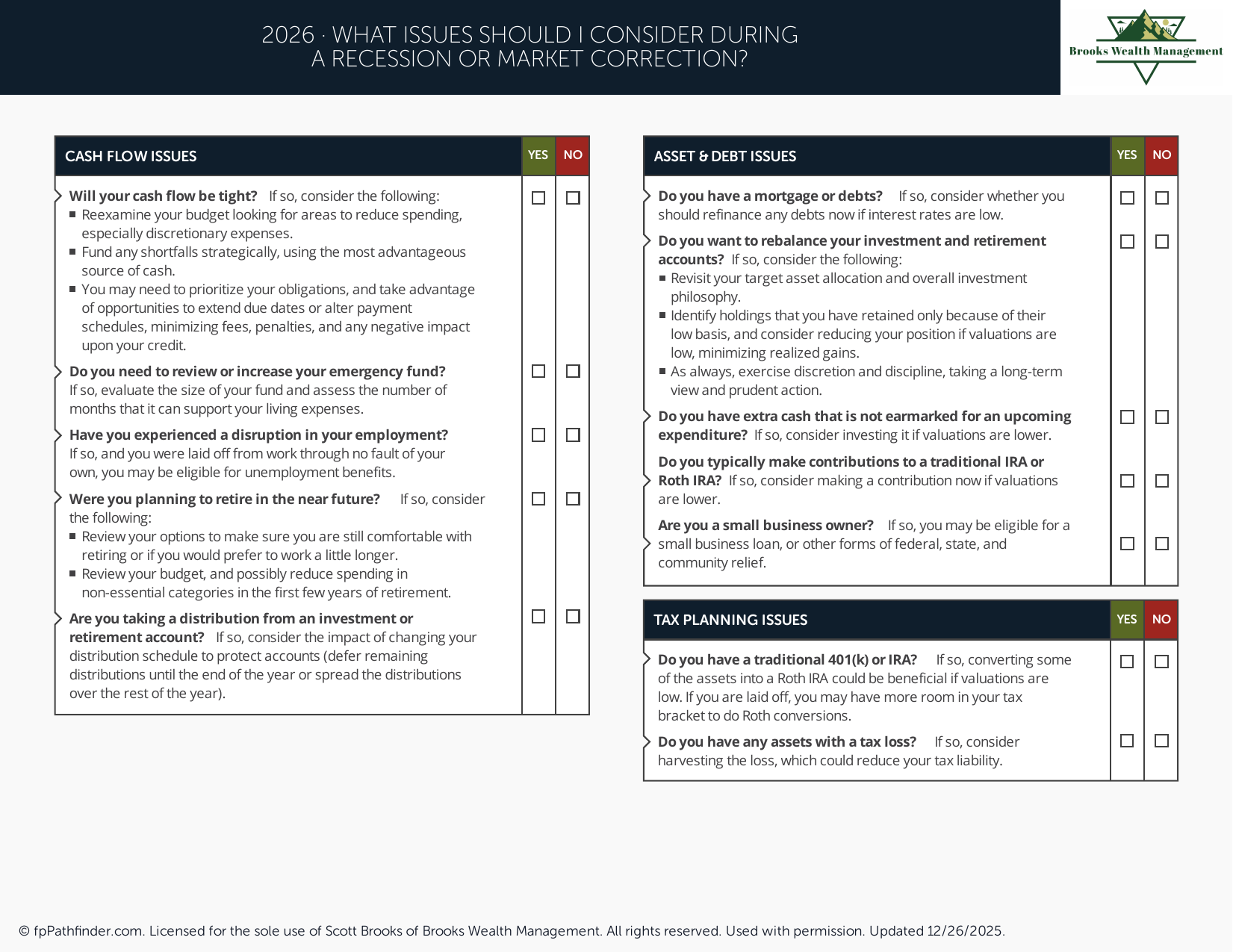
About This Resource
Market downturns, bear markets, and recessions can be among the most challenging periods for investors. Falling account balances, negative headlines, economic uncertainty, and increased volatility often create pressure to make significant financial decisions at exactly the time when emotions may be strongest.
This checklist was created to help individuals answer the question, What Issues Should I Consider When Investing During a Recession? It provides a structured framework for reviewing common financial planning, investment, and behavioral considerations that often arise during periods of economic uncertainty.
Review Your Emergency Fund and Cash Reserves
Before focusing on investment decisions, many individuals begin by reviewing their cash reserves. Adequate emergency savings may help reduce the need to sell long-term investments during unfavorable market conditions.
Common considerations include available cash reserves, expected living expenses, employment stability, upcoming major purchases, and access to other sources of liquidity.
Individuals often review whether their emergency fund remains appropriate given current economic conditions and personal circumstances.
Review Your Investment Allocation
Market declines can cause investors to reassess risk tolerance and portfolio structure. A recession may reveal whether a portfolio's current allocation aligns with an individual's ability and willingness to tolerate market volatility.
Common review areas include:
- Current stock and bond allocation
- Diversification across asset classes
- Concentrated stock positions
- International and domestic exposure
- Alignment with long-term financial goals
Market volatility does not necessarily mean an investment strategy should change, but it may provide an opportunity to review whether the portfolio remains consistent with the original investment plan.
Review Behavioral Risks During Market Declines
One of the most significant risks during a recession may not be the market itself but investor behavior. Research has consistently shown that emotional investment decisions can negatively affect long-term outcomes.
Periods of economic uncertainty often increase the temptation to:
- Sell investments after a decline
- Move entirely to cash
- Attempt to predict market bottoms
- Abandon a long-term investment strategy
- Make decisions based primarily on headlines
Reviewing investment decisions through the lens of long-term goals rather than short-term market movements may help maintain consistency during volatile periods.
Review Tax Planning Opportunities
Market declines may create tax planning opportunities that are not available during stronger market environments. Individuals often review whether current market values create opportunities for additional analysis.
Common considerations may include tax-loss harvesting, capital gains planning, charitable gifting strategies, and the tax implications of portfolio rebalancing.
Tax considerations vary significantly based on individual circumstances and account structures.
Review Roth Conversion Considerations
Some investors review Roth conversions during market downturns because account values may be lower than they were previously. Lower account values can affect the amount of taxable income generated from a conversion.
Reviewing a potential Roth conversion often involves evaluating:
- Current and future tax brackets
- Available funds to pay conversion taxes
- Retirement income projections
- Existing retirement account balances
- Long-term planning objectives
Additional information may be found in our resources regarding Roth conversions.
Review Rebalancing Opportunities
Market declines may cause portfolio allocations to drift away from their intended targets. Investors often review whether rebalancing is appropriate after significant changes in market values.
Rebalancing considerations may include tax consequences, transaction costs, cash flow needs, and the location of assets across various account types.
The objective of rebalancing is generally to maintain the portfolio's intended risk profile rather than react to short-term market movements.
Review Retirement and Long-Term Goals
Individuals approaching retirement may have additional concerns during a recession because market declines can affect account balances, withdrawal plans, and future income projections.
Common review topics include:
- Retirement spending assumptions
- Withdrawal strategies
- Sequence of returns risk
- Social Security planning
- Long-term income needs
For younger investors, a recession may provide an opportunity to review savings rates, contribution levels, and long-term investment objectives.
Related Resources
Individuals reviewing recession-related investment decisions may also find these resources helpful:
- What Issues Should I Consider When Reviewing My Investments?
- Should I Consider Doing a Roth Conversion?
- Where Should My Next Dollar Go?
- Financial Planning Resource Library
Using This Checklist
This checklist is intended to serve as a starting point for reviewing investment and financial planning considerations during a recession. It is designed to help individuals organize their thinking around common issues that often arise during periods of market volatility and economic uncertainty.
Whether an investor should make changes to a financial plan or investment portfolio depends on individual circumstances, goals, time horizon, risk tolerance, and overall financial situation.