
What Issues Should I Consider When Reviewing My Investments?
Checklist for reviewing asset allocation, fees, performance, and rebalancing needs in your investment portfolio.
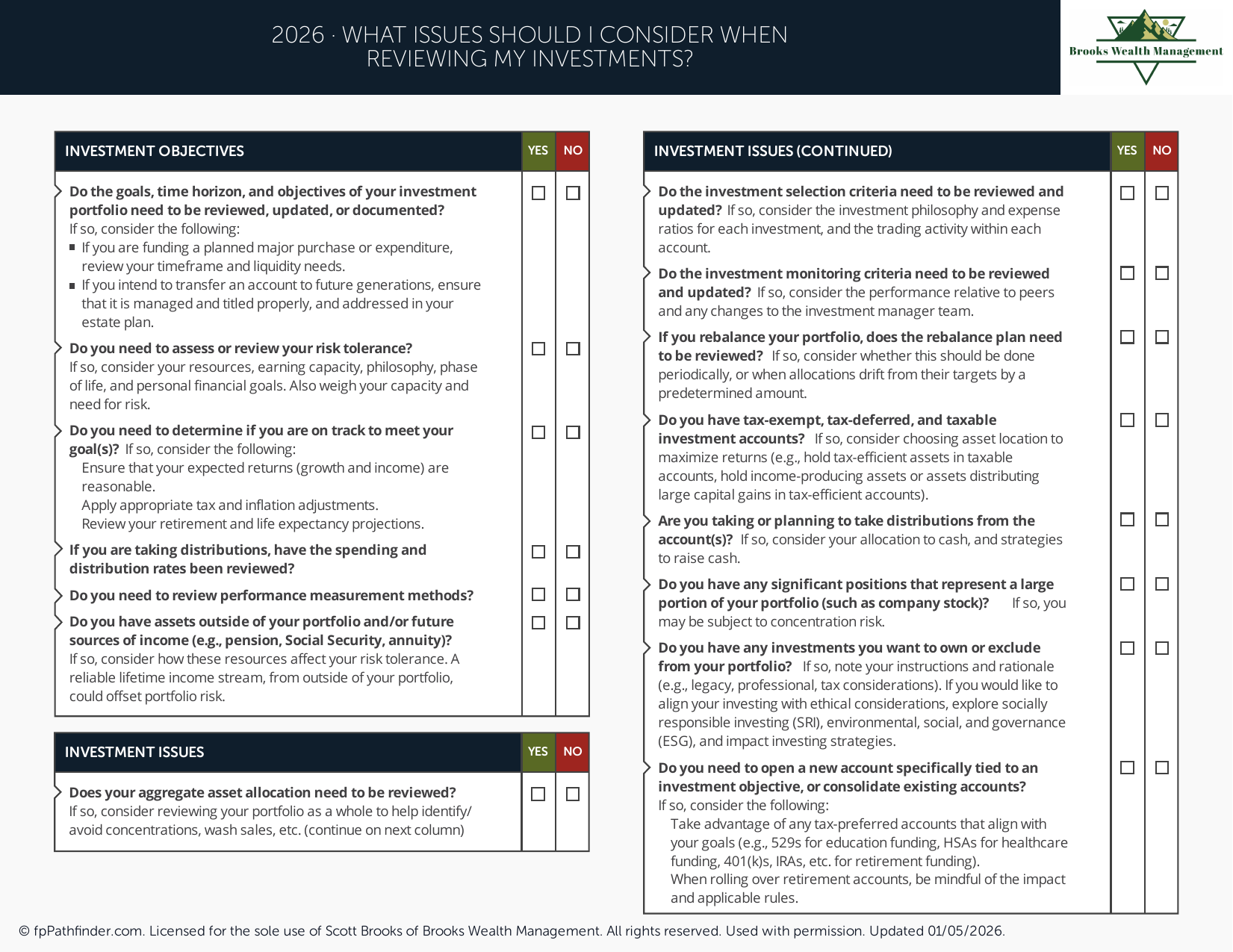
About This Resource
Investment decisions often involve more than reviewing recent returns. A comprehensive investment review may include evaluating portfolio allocation, diversification, risk exposure, fees and expenses, tax efficiency, account structure, and how investments align with current financial goals.
This checklist was created to help individuals answer the question, What Issues Should I Consider When Reviewing My Investments? It provides a structured framework for evaluating an investment portfolio and identifying areas that may warrant additional review. Many investors use resources like this during annual financial reviews, before retirement, after major life events, or when considering changes to their investment strategy.
Review Asset Allocation and Diversification
Asset allocation is one of the primary drivers of portfolio risk and return characteristics. Over time, market movements can cause a portfolio to drift away from its intended allocation. Reviewing stock, bond, cash, and alternative investment exposures may help identify whether the portfolio still aligns with an investor's objectives, time horizon, and risk tolerance.
Diversification considerations may include exposure across market sectors, company sizes, geographic regions, investment styles, and asset classes. Concentrated positions can introduce additional risks that may not always be apparent during strong market environments.
Review Investment Costs and Fees
Investment expenses may affect long-term outcomes over time. Reviewing fund expense ratios, advisory fees, trading costs, account fees, and other investment-related expenses can help investors understand the total cost of implementing their investment strategy.
While lower costs do not guarantee better results, understanding what is being paid and why can be an important part of an informed investment review process.
Review Portfolio Risk and Volatility
Market conditions, personal circumstances, and financial goals can change over time. Reviewing portfolio risk may help determine whether current investments remain appropriate for an investor's situation.
Common considerations include downside risk, concentration risk, liquidity needs, sequence-of-returns risk for retirees, and the potential impact of market volatility on future financial goals.
Review Tax Efficiency
Taxes may affect investment outcomes, particularly in taxable brokerage accounts. Investors often review asset location, capital gains exposure, tax-loss harvesting opportunities, dividend distributions, and the tax characteristics of various investment holdings.
Tax considerations may also become increasingly important when preparing for retirement, selling a business, exercising stock options, managing concentrated stock positions, or implementing charitable giving strategies.
Review Rebalancing Needs
Over time, market performance can cause portfolio allocations to move away from their intended targets. Periodic reviews may identify situations where rebalancing should be considered to maintain a portfolio's desired risk profile.
Rebalancing decisions may involve tax considerations, transaction costs, available cash flows, and the location of assets across retirement and taxable accounts.
Review Changes in Your Financial Situation
Investment decisions do not occur in isolation. Changes in income, family circumstances, employment, retirement goals, business ownership, inheritance, or healthcare needs may affect how a portfolio should be evaluated.
An investment strategy that was appropriate several years ago may warrant review if personal circumstances have changed significantly.
Who May Find This Checklist Helpful?
This resource may be useful for individuals who are:
- Approaching retirement
- Recently retired
- Accumulating wealth during peak earning years
- Managing employer stock or concentrated positions
- Reviewing a 401(k), IRA, or brokerage account
- Experiencing major life or career transitions
- Evaluating investment expenses and portfolio structure
- Looking to better understand their current investment allocation
Using This Checklist
This checklist is intended to serve as a starting point for reviewing an investment portfolio. It is not designed to provide recommendations or prescribe specific actions. Instead, it highlights common issues that investors often evaluate when assessing whether their investments continue to align with their financial goals and overall financial plan.
If you would like to discuss how these considerations apply to your financial situation, we invite you to schedule an introductory conversation.