
Should I Pay Off My Mortgage?
Decision flowchart to evaluate whether paying off your mortgage early is the right financial move.
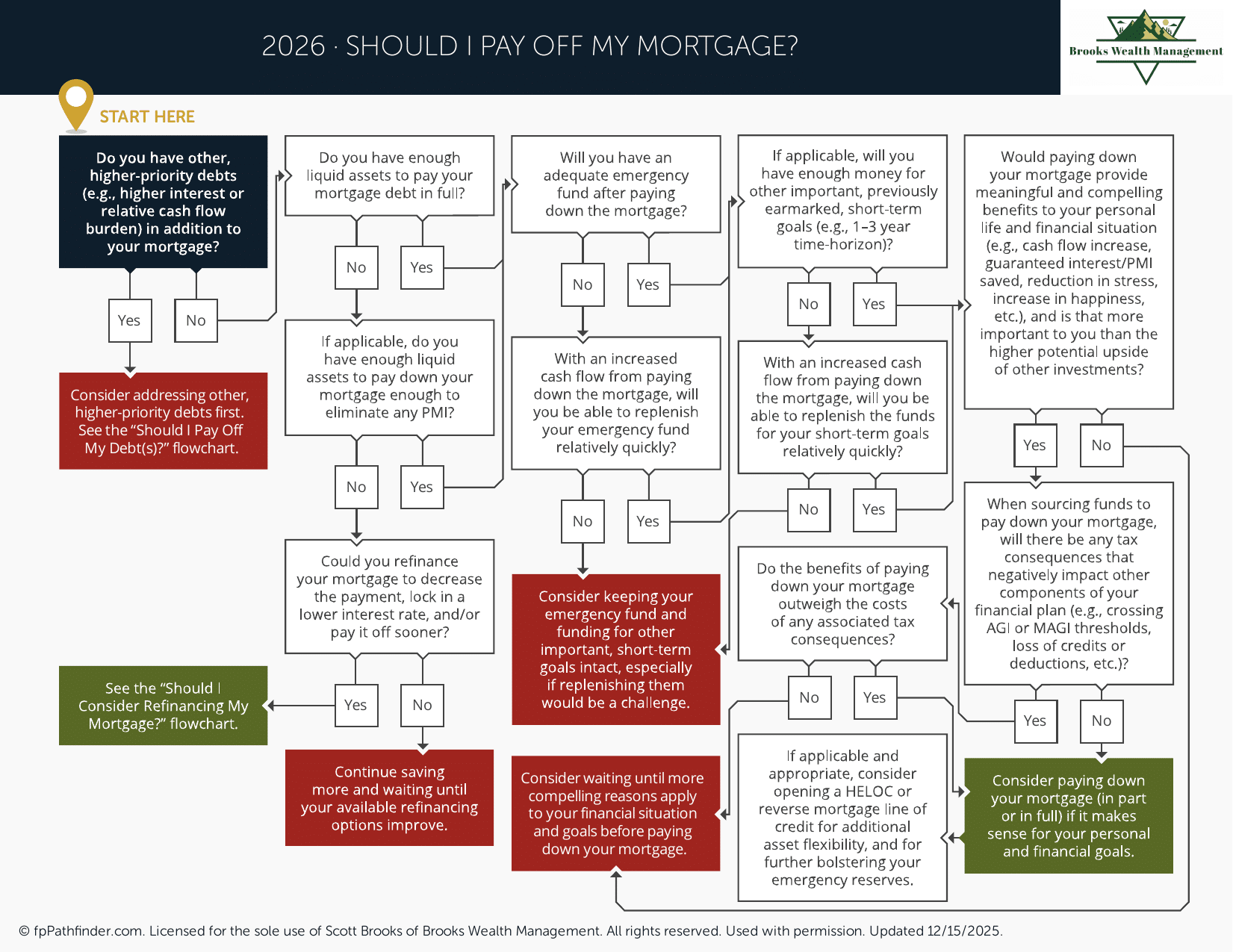
Should I Pay Off My Mortgage Early?
Deciding whether to pay off a mortgage early is one of the most common financial planning questions homeowners face. While eliminating debt can be appealing, the answer is rarely as simple as "yes" or "no." The appropriate decision often depends on a variety of factors including interest rates, cash flow, investment opportunities, retirement goals, risk tolerance, tax considerations, and overall financial priorities.
This checklist is designed to help homeowners evaluate the issues that may be worth considering before making additional mortgage payments or accelerating a mortgage payoff strategy.
Review Your Overall Financial Priorities
Before directing additional funds toward a mortgage, it can be helpful to evaluate how the decision fits within your broader financial plan. Every dollar used to reduce mortgage debt is a dollar that cannot simultaneously be used for another financial objective.
Questions worth considering include:
- Are emergency reserves adequately funded?
- Are retirement savings goals on track?
- Are there higher-priority financial goals?
- Are there higher-interest debts that deserve attention first?
- Will additional mortgage payments affect financial flexibility?
Understanding where mortgage repayment fits among competing priorities can provide valuable context when evaluating the decision.
Related resources include Where Should My Next Dollar Go? and What Issues Should I Consider During a Cash Flow Review?.
Review Your Mortgage Interest Rate
The interest rate on a mortgage is often one of the most important factors in the analysis. Mortgage debt may be viewed differently depending on the cost of borrowing relative to other available uses of capital.
Areas worth reviewing include:
- The current mortgage interest rate
- Whether the rate is fixed or variable
- The remaining loan term
- The total interest expected over the life of the loan
- The monthly payment obligation
Understanding the cost of the mortgage can help homeowners evaluate the potential benefits and tradeoffs of making additional principal payments.
Review Investment Opportunities and Opportunity Cost
One of the primary considerations in a mortgage payoff decision is opportunity cost. Funds used to reduce mortgage debt are no longer available for savings, investing, business opportunities, or other financial goals.
Questions worth considering include:
- Could the funds be used elsewhere?
- Are retirement accounts being adequately funded?
- Are there investment goals that remain unfunded?
- Would additional liquidity provide greater flexibility?
- How does the mortgage strategy fit within long-term wealth-building objectives?
Evaluating alternative uses of capital can help place the mortgage decision within a broader financial planning framework.
You may also find it helpful to review What Accounts Should I Consider If I Want to Save More?.
Review Emergency Reserves and Liquidity Needs
Mortgage prepayments increase home equity but generally reduce liquidity. Home equity may represent substantial wealth, but it is not typically as accessible as cash reserves or liquid investment accounts.
Questions that may warrant review include:
- Is there an adequate emergency fund?
- Could future expenses require readily available cash?
- Are there upcoming life events that may require liquidity?
- Would additional mortgage payments reduce financial flexibility?
- How stable are income sources?
Maintaining appropriate liquidity can be particularly important during periods of economic uncertainty, career transitions, or major life changes.
Review Retirement Planning Goals
For many households, the decision to pay off a mortgage is closely connected to retirement planning. Some individuals prioritize entering retirement with reduced housing expenses, while others may place greater emphasis on maintaining flexibility and preserving investment assets.
Areas commonly reviewed include:
- Retirement timing objectives
- Expected retirement income sources
- Future housing costs
- Retirement savings progress
- Withdrawal planning considerations
Understanding how mortgage debt fits into retirement plans can help determine whether accelerated repayment aligns with long-term objectives.
Related resources include What Issues Should I Consider Before I Retire?.
Review Tax Considerations
Mortgage-related decisions can involve tax considerations that may affect the overall analysis. Because tax circumstances vary significantly between households, these factors are often evaluated within the context of an individual's broader tax situation.
Potential areas that may warrant review include:
- Mortgage interest deductions
- Changes in taxable income
- State and federal tax considerations
- Investment-related tax implications
- Alternative uses of funds that may have tax consequences
Tax considerations are generally only one component of the decision but may still influence the overall outcome.
Review the Psychological and Lifestyle Considerations
Financial decisions are not always driven solely by mathematics. Personal preferences, risk tolerance, and lifestyle considerations often play a meaningful role.
Some homeowners value:
- The feeling of being debt-free
- Reducing monthly obligations
- Simplifying financial affairs
- Increasing peace of mind
- Eliminating housing-related debt before retirement
Others may prioritize:
- Maintaining liquidity
- Preserving flexibility
- Retaining access to capital for future opportunities
- Building investment accounts
Neither perspective is inherently right or wrong. Understanding personal preferences can be an important part of the evaluation process.
Review Alternative Approaches
The decision is not always limited to paying off the mortgage entirely or making no additional payments at all. Some homeowners choose intermediate approaches that balance multiple objectives.
Examples may include:
- Making occasional additional principal payments
- Splitting excess cash flow between investing and debt reduction
- Targeting a specific payoff date
- Increasing retirement contributions before accelerating mortgage payments
- Building additional reserves before making extra payments
Evaluating multiple approaches can help identify a strategy that aligns with both financial objectives and personal preferences.
About This Resource
This checklist was created to help homeowners evaluate the issues associated with paying off a mortgage early. The objective is to provide a structured framework for reviewing financial priorities, liquidity needs, retirement goals, investment opportunities, tax considerations, and personal preferences.
Every financial situation is unique. Factors such as mortgage terms, income stability, investment objectives, retirement plans, risk tolerance, and available assets can all influence the appropriate course of action. Reviewing these issues carefully can help support informed decision-making and alignment with broader financial goals.
This resource is provided for educational purposes only and should not be construed as investment, tax, legal, mortgage, or financial advice. Individuals should consult appropriate professionals regarding their specific circumstances before implementing any financial strategy.