
How Must I Take Distributions from the Roth IRA I Inherited?
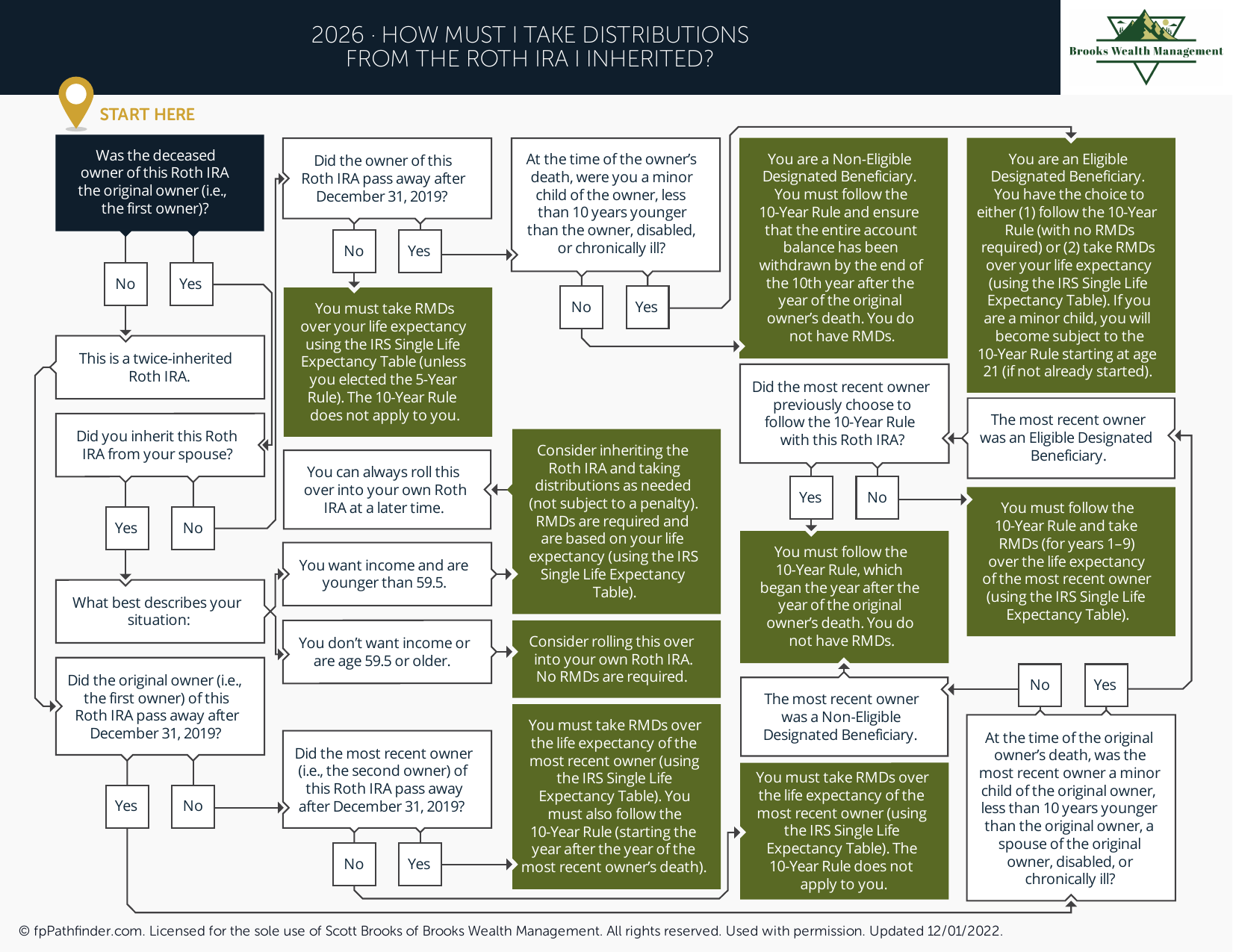
Flowchart for distribution requirements on an inherited Roth IRA.
What Should I Know About Inherited Roth IRA Distributions?
Inherited Roth IRA distributions are generally tax-free, but beneficiaries are still subject to distribution rules and deadlines that may affect long-term planning. The specific requirements depend on your relationship to the original account owner, the age of the account, and whether you qualify for an exception to the standard distribution rules.
Many beneficiaries focus on the tax-free nature of a Roth IRA and overlook the required distribution timeline. Reviewing these rules early may help preserve flexibility and avoid unnecessary mistakes.
Review Whether the 10-Year Rule Applies
Many non-spouse beneficiaries who inherit a Roth IRA are subject to the SECURE Act 10-year rule. Under this rule, the inherited Roth IRA generally must be fully distributed by December 31 of the tenth year following the original owner's death.
- Date of death of the original owner
- Beneficiary classification
- Whether an exception applies
- Timing of future withdrawals
Although the account must typically be emptied within ten years, beneficiaries often have flexibility regarding when distributions occur during that period.
Review Whether You Qualify as an Eligible Designated Beneficiary
Certain beneficiaries may qualify for special treatment that allows distributions to be taken over life expectancy rather than under the 10-year rule.
- Surviving spouse
- Minor child of the original owner
- Disabled individual
- Chronically ill individual
- Beneficiary not more than ten years younger than the original owner
Individuals who qualify as eligible designated beneficiaries may have additional planning opportunities available.
Review Spousal Beneficiary Options
Surviving spouses generally have more flexibility than other beneficiaries when inheriting a Roth IRA. Several options may be available depending on age, retirement goals, and income needs.
- Treating the Roth IRA as your own
- Completing a spousal rollover
- Maintaining the account as an inherited Roth IRA
- Reviewing future distribution requirements
The most appropriate option often depends on individual circumstances and broader retirement planning considerations.
Review the Roth IRA Five-Year Rule
Inherited Roth IRA distributions may be tax-free if the original Roth IRA satisfied the five-year holding requirement. The five-year period is based on the original owner's Roth IRA history, not the beneficiary's holding period.
- Date of the original Roth IRA contribution
- Length of time the account has existed
- Tax treatment of earnings
- Potential tax consequences of distributions
Reviewing the five-year rule may help determine whether distributions of earnings will be tax-free.
Review the Tax Treatment of Future Distributions
One of the primary benefits of an inherited Roth IRA is that qualified distributions are generally tax-free. However, understanding the applicable rules remains important before making withdrawal decisions.
- Tax-free distribution eligibility
- Impact on taxable income
- Future tax planning opportunities
- Coordination with other retirement assets
Unlike traditional inherited IRAs, qualified inherited Roth IRA distributions generally do not increase taxable income.
Review Distribution Timing Considerations
Beneficiaries often review whether to take distributions gradually or leave assets invested until later in the distribution period. The decision may affect future investment growth, liquidity needs, and estate planning objectives.
- Current cash flow needs
- Investment time horizon
- Expected market growth
- Future financial goals
Because qualified Roth IRA growth remains tax-free, delaying distributions may be beneficial in certain circumstances.
Review How the Inherited Roth IRA Fits Into Your Overall Financial Plan
An inherited Roth IRA may affect retirement planning, tax planning, investment decisions, and legacy goals. Reviewing the account within the context of your broader financial picture may help support more informed decisions.
- Retirement income planning
- Estate planning objectives
- Tax diversification
- Investment allocation decisions
You may also find additional context in our resources on Roth conversions, Roth 401(k) planning, and retirement planning considerations available in the free resource library.
About This Resource
This resource provides general educational information regarding inherited Roth IRA distributions and beneficiary planning. Individuals often review inherited Roth IRA rules when evaluating distribution deadlines, tax-free withdrawal opportunities, retirement planning considerations, and estate planning goals.
The rules governing inherited Roth IRAs depend on beneficiary classification, the age of the account, and the circumstances of the original owner's death. Distribution requirements and tax rules may change over time.
This resource is intended to help identify the major issues that may be relevant when evaluating inherited Roth IRA distribution options.
If you would like to discuss how this topic fits into your broader financial plan, we invite you to schedule an introductory conversation.