
Can I Contribute to My Roth IRA?
Flowchart to determine Roth IRA contribution eligibility based on income and filing status.
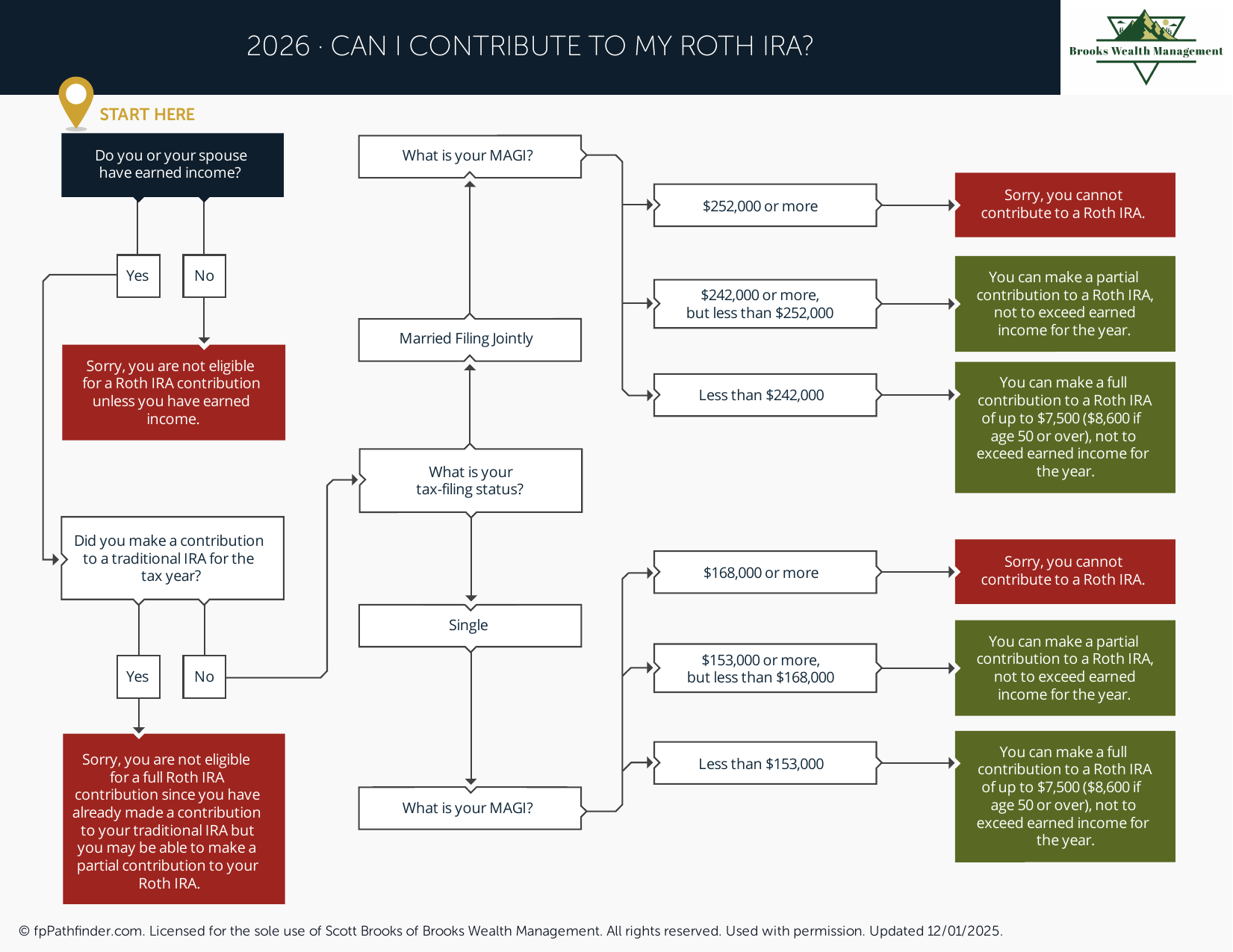
Can I Contribute to a Roth IRA in 2026?
Whether an individual can contribute directly to a Roth IRA in 2026 depends primarily on earned income, tax filing status, and modified adjusted gross income (MAGI). Some individuals may qualify for the full contribution amount, while others may qualify for a reduced contribution or may not be eligible for a direct Roth IRA contribution.
Individuals often review Roth IRA eligibility as part of broader retirement planning because contribution limits and income thresholds can affect which retirement savings strategies are available.
Review Roth IRA Eligibility Requirements
To contribute to a Roth IRA, an individual generally must have earned income and meet applicable IRS income requirements. Eligibility is largely determined by modified adjusted gross income and filing status.
As income increases, the amount that can be contributed to a Roth IRA may be reduced. Once income exceeds the applicable phase-out range, direct Roth IRA contributions may no longer be permitted.
- Modified adjusted gross income (MAGI)
- Tax filing status
- Amount of earned income
- Annual Roth IRA contribution limits
- Applicable IRS phase-out ranges
Individuals approaching retirement may also benefit from reviewing common issues to consider before retirement.
Review Roth IRA Income Limit Considerations
The IRS establishes income thresholds that determine whether an individual can make a full Roth IRA contribution, a partial contribution, or no direct contribution at all. These thresholds are periodically adjusted and may change from year to year.
Individuals whose income falls within the phase-out range may be eligible to contribute a reduced amount. Those whose income exceeds the upper limit of the applicable phase-out range may need to consider alternative retirement savings strategies.
- Income below the phase-out range may allow a full contribution
- Income within the phase-out range may allow a partial contribution
- Income above the phase-out range may prevent direct contributions
- Different rules apply to different filing statuses
Because these limits may change over time, individuals often review current IRS guidance before making contributions.
Review Roth IRA Contribution Limits and Deadlines
In addition to income requirements, Roth IRAs are subject to annual contribution limits. These limits apply across all Roth IRA accounts owned by the individual and may be adjusted periodically for inflation.
Individuals age 50 and older may also qualify for additional catch-up contributions, depending on applicable IRS rules.
- Annual contribution limits may change over time
- Catch-up contribution rules may apply for older savers
- Contributions generally require earned income
- The contribution deadline is typically the tax filing deadline for that year
Individuals evaluating multiple savings opportunities may also wish to review accounts that may be appropriate to consider when saving more.
Review Backdoor Roth IRA Considerations
Some high-income individuals review a backdoor Roth IRA strategy when direct Roth IRA contributions are unavailable because of income limitations. This generally involves making a non-deductible traditional IRA contribution followed by a Roth conversion.
The tax consequences of a backdoor Roth IRA can vary based on individual circumstances. Existing traditional IRA, SEP IRA, and SIMPLE IRA balances may affect the taxation of a conversion because of the pro-rata rule.
- Existing pre-tax IRA balances
- Application of the pro-rata rule
- Timing of contributions and conversions
- Potential taxable income resulting from a conversion
- Required recordkeeping and reporting
Individuals reviewing this strategy may also wish to learn more about Roth conversion considerations.
Review Why Individuals Consider Roth IRAs
Roth IRAs are often reviewed because qualified withdrawals may be tax-free if applicable requirements are met. In addition, Roth IRAs generally do not require lifetime required minimum distributions for the original account owner under current rules.
Common considerations include:
- Current versus future tax rates
- Retirement income planning objectives
- Tax diversification across account types
- Estate and legacy planning considerations
- Flexibility in retirement withdrawal planning
Whether a Roth IRA is appropriate to review depends on individual circumstances, financial goals, and overall retirement planning objectives.
Additional educational materials are available through our free resources.
About This Resource
This resource provides general educational information regarding Roth IRA contributions. It is not intended as investment, tax, legal, insurance, healthcare, cybersecurity, or financial advice. Individual circumstances vary and rules may change over time.
If you would like to discuss how this topic fits into your broader financial plan, we invite you to schedule an introductory conversation.