
What Will Have the Least Tax Impact — Harvesting Capital Gains or Roth Conversions?
Flowchart to compare the tax impact of harvesting capital gains vs. doing a Roth conversion.
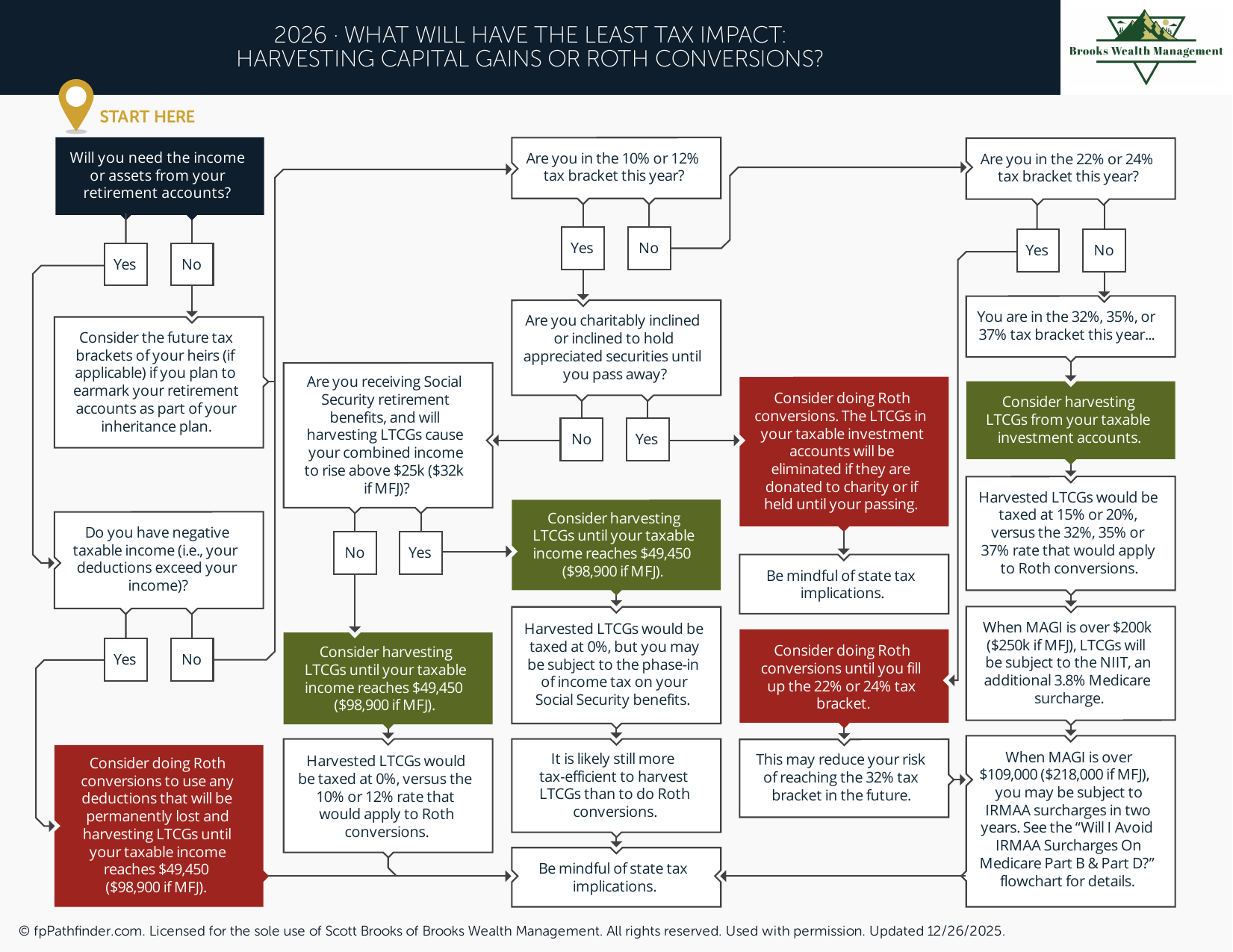
What Will Have the Least Tax Impact: Harvesting Capital Gains or Roth Conversions?
The tax impact of harvesting capital gains and completing Roth conversions depends on individual circumstances. Factors such as current income, tax bracket, available deductions, future income expectations, and existing retirement account balances may all affect the outcome.
Individuals often review these strategies as part of broader tax and retirement planning discussions. While both can influence current and future tax obligations, they serve different purposes and may be appropriate under different circumstances.
Review Capital Gains Harvesting Considerations
Capital gains harvesting generally involves intentionally realizing investment gains in a taxable account. In some situations, individuals may choose to realize gains during years when their tax rate is lower than expected or when other tax attributes may offset part of the gain.
Common considerations include:
- Current taxable income and tax bracket
- Availability of capital loss carryforwards
- Expected future tax rates
- Changes to investment allocation or portfolio structure
- Potential effects on other tax-related items
Individuals reviewing investment-related tax strategies may also wish to explore additional educational resources regarding investment planning topics.
Review Roth Conversion Considerations
A Roth conversion generally involves transferring assets from a pre-tax retirement account, such as a traditional IRA, into a Roth IRA. The converted amount is typically included in taxable income during the year of conversion.
Because Roth IRAs may provide tax-free qualified withdrawals in retirement, some individuals review Roth conversions when evaluating long-term tax planning opportunities.
Common considerations include:
- Current and anticipated future tax brackets
- Available funds to pay conversion-related taxes
- Retirement income projections
- Estate and legacy planning objectives
- Required minimum distribution considerations
Additional background information can be found in our resource discussing whether a Roth conversion may be appropriate to review.
Review How the Tax Impact May Differ
Capital gains harvesting and Roth conversions affect taxes in different ways. Capital gains harvesting generally focuses on investment gains within taxable accounts, while Roth conversions involve moving assets between retirement account types and recognizing taxable income in the year of conversion.
Common considerations when comparing the two include:
- The amount of additional taxable income created
- Federal and state income tax implications
- The timing of tax payments
- Expected future tax rates
- Effects on retirement income planning
For some individuals, one strategy may result in less immediate tax impact. For others, a combination of strategies may be reviewed as part of a broader planning process.
Review Factors That May Affect the Decision
Several factors may influence whether harvesting capital gains, completing Roth conversions, or pursuing neither strategy aligns with an individual's goals.
- Income Levels: Current and projected income may affect tax rates and planning opportunities.
- Investment Holdings: Unrealized gains, losses, and account types may influence available options.
- Retirement Timeline: Time horizon may affect the potential benefits and trade-offs of each strategy.
- Tax Law Changes: Future legislative changes may affect outcomes.
- Cash Flow Needs: Available liquidity may affect the feasibility of certain planning decisions.
Individuals approaching retirement may also benefit from reviewing broader retirement planning considerations, including issues that are commonly reviewed before retirement.
About This Resource
This resource provides general educational information regarding capital gains harvesting and Roth conversions. It is not intended as investment, tax, legal, insurance, healthcare, cybersecurity, or financial advice. Individual circumstances vary and rules may change over time.
If you would like to discuss how this topic fits into your broader financial plan, we invite you to schedule an introductory conversation.