
What Issues Should I Consider with My Employer-Provided Benefits?
Checklist for evaluating and optimizing employer-provided benefits including health, retirement, and equity plans.
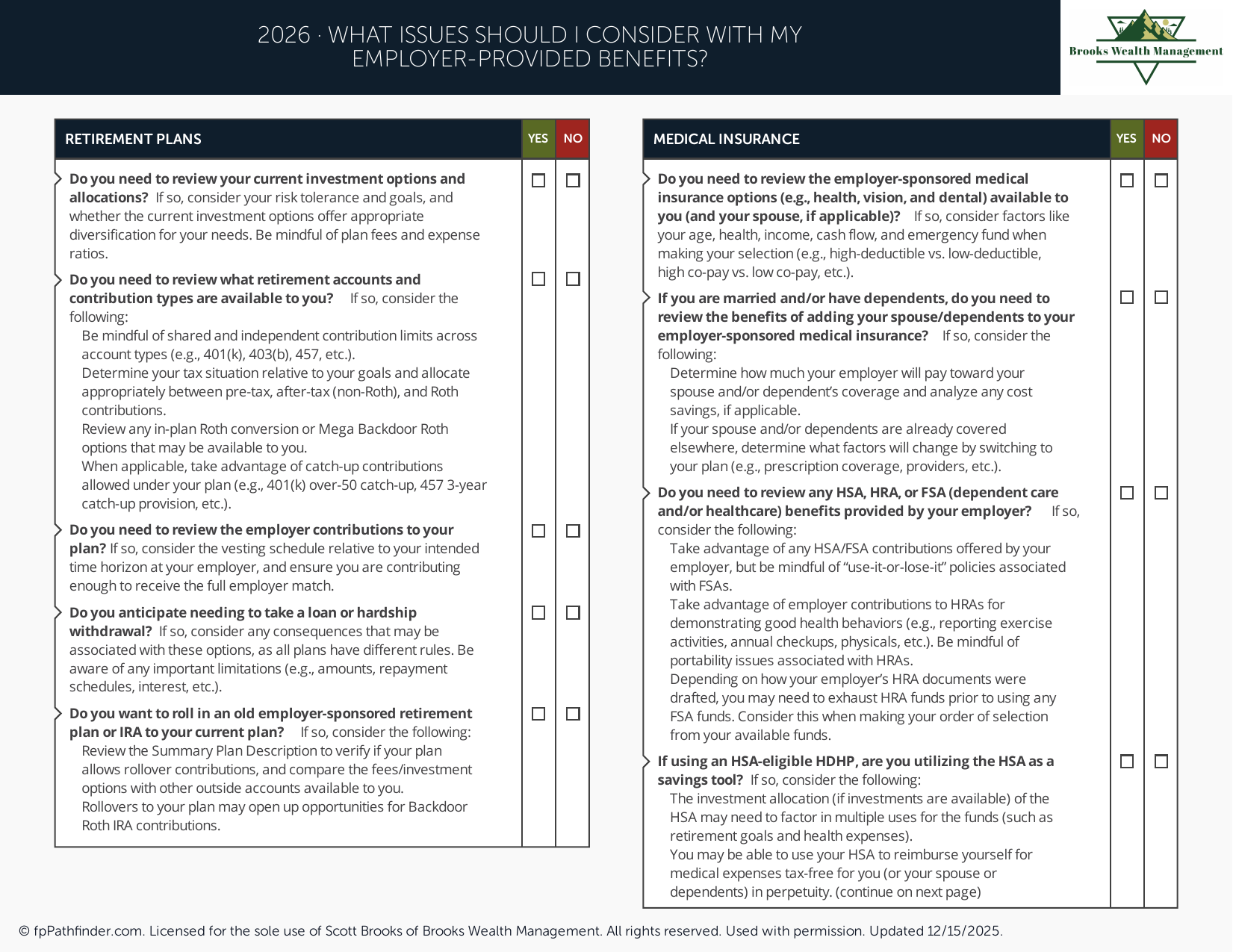
Understanding Your Employer Benefits: A Comprehensive Guide
As a high-income professional, your employer benefits package is often a significant component of your overall compensation. It’s more than just a paycheck; it includes a complex array of offerings that can profoundly impact your financial well-being, both now and in retirement. Understanding these benefits and making informed decisions about them is crucial for optimizing your financial strategy. Many individuals overlook the nuances of their employer benefits, potentially leaving valuable opportunities on the table or making choices that don't align with their long-term goals.
When evaluating your employer benefits, it's essential to look beyond the surface. This guide will walk you through the critical issues you should consider to ensure you are maximizing the value of your employer-provided perks and aligning them with your personal financial plan. From retirement accounts to health insurance and equity compensation, each element requires careful consideration.
Maximizing Your Retirement Plan Contributions
One of the most powerful aspects of your employer benefits package is often the retirement plan, typically a 401(k) or 403(b). The first step is to consider to contribute at least enough to receive the full employer match. Beyond the match, consider maximizing your contributions up to the IRS limits. For 2026, these limits are substantial, allowing you to defer a significant portion of your income into a tax-advantaged account. For those looking to save even more, explore whether your plan offers a Roth 401(k) option or an after-tax contribution feature that could enable a mega backdoor Roth conversion. Understanding these advanced strategies can dramatically accelerate your retirement savings. For more insights on saving, visit our page on what accounts to consider if you want to save more.
Navigating Health, Disability, and Life Insurance Options
Beyond retirement, your employer benefits include vital insurance coverages. Health insurance is a primary concern, and you should carefully compare plan options like PPOs, HMOs, and High-Deductible Health Plans (HDHPs) with Health Savings Accounts (HSAs). An HSA, if available, is a triple-tax-advantaged account that can be a powerful savings vehicle, especially for high-income earners. Disability insurance, both short-term and long-term, is equally critical. Your ability to earn an income is your greatest asset, and adequate disability coverage protects that. Review the benefit period, elimination period, and definition of disability. Often, employer-provided long-term disability is insufficient, and supplementing it with a private policy is advisable. Finally, assess your group life insurance. While convenient, it may not provide enough coverage for your family's needs, particularly if you have significant financial obligations. Consider additional term life insurance outside of your employer's plan.
Understanding Equity Compensation and Stock Options
For many professionals, especially in tech or growing companies, equity compensation like stock options, Restricted Stock Units (RSUs), or Employee Stock Purchase Plans (ESPPs) are a key part of their employer benefits. These can be incredibly valuable but also complex. With stock options, understanding the difference between Incentive Stock Options (ISOs) and Non-Qualified Stock Options (NSOs) is paramount, as their tax treatment varies significantly. You'll need a strategy for when to exercise and when to sell, considering vesting schedules, strike prices, and potential Alternative Minimum Tax (AMT) implications. RSUs are generally simpler, taxed as ordinary income upon vesting, but still require careful planning regarding diversification. ESPPs can offer an immediate, low-risk return if you can purchase company stock at a discount and sell it quickly. Integrating these equity awards into your broader financial plan is essential to avoid overconcentration in a single company's stock.
Evaluating Other Valuable Employer Benefits
Beyond the major categories, many other employer benefits can offer significant value. These might include tuition reimbursement, student loan repayment assistance, commuter benefits, dependent care Flexible Spending Accounts (FSAs), or even legal services. Take the time to understand each offering and how it can benefit your specific situation. For instance, a Dependent Care FSA can provide tax savings for childcare expenses, while tuition reimbursement can be a game-changer for career development. Even seemingly small perks can add up. Additionally, some employers offer financial wellness programs or access to financial advisors. These resources can be invaluable for making sense of your entire benefits package and integrating it into your overall financial strategy. If you are also considering other financial decisions, such as managing debt, you might find our article on should I pay off my debts helpful.
About This Resource
At Brooks Wealth Management, we believe in empowering high-income professionals and business owners with the knowledge to make smart financial decisions. This guide on employer benefits is designed to provide clarity and actionable insights. We encourage you to review your benefits package thoroughly and consider how each component fits into your personal financial roadmap. For a personalized discussion on optimizing your employer benefits and integrating them into a comprehensive financial plan, we invite you to book a consultation with our team. Visit our contact page to schedule your initial meeting today.
Have Questions About Your Situation?
This resource is a starting point. A free consultation with Scott Brooks, CFP® gives you a personalized perspective.
Book a Free ConsultationBased in Westlake Village, CA · Ventura County
Brooks Wealth Management is a Registered Investment Adviser (RIA) in the State of California. Registration does not imply a certain level of skill or training. This resource is provided for educational and informational purposes only and does not constitute investment, tax, or legal advice. Scott Brooks, CFP® · CRD #7227609 · Firm CRD #332237 · 2555 Townsgate Rd STE 200, Westlake Village, CA 91361