
What Issues Should I Consider When Purchasing Disability Insurance?
Checklist of coverage definitions, benefit periods, and policy features to evaluate when buying disability insurance.
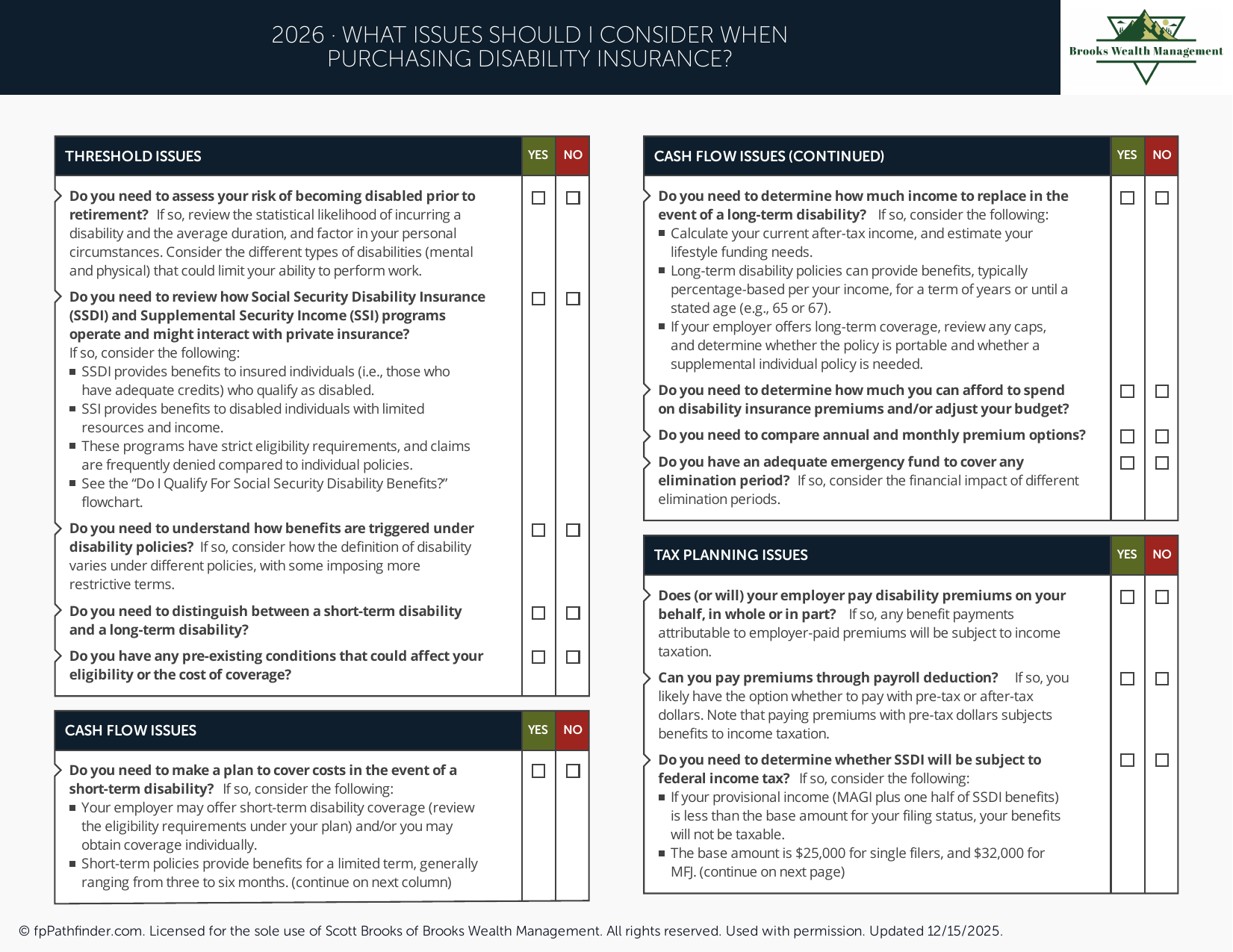
What Issues Should I Consider When Purchasing Disability Insurance?
For many individuals, future earning potential represents one of the most significant financial resources they possess. Income often supports day-to-day living expenses, retirement savings, debt repayment, family obligations, and long-term financial goals. As a result, some individuals evaluate disability insurance as part of a broader risk management strategy designed to address the possibility of a temporary or long-term inability to work.
This checklist is designed to help organize common considerations when evaluating disability insurance coverage. The objective is not to determine whether disability insurance is appropriate for any particular individual or to recommend a specific policy. Instead, it provides a framework for reviewing policy features, coverage options, and planning considerations that may be relevant during the evaluation process.
Review How Disability Insurance Fits Within Your Financial Plan
Disability insurance is often evaluated alongside emergency savings, retirement planning, employer benefits, healthcare coverage, and overall financial risk management. Because financial circumstances vary significantly from one household to another, the role disability insurance may play can differ as well.
Some individuals have access to disability coverage through an employer, while others may evaluate individual policies. Understanding what coverage already exists, if any, can provide a useful starting point before evaluating additional insurance options.
Individuals reviewing broader employee benefit considerations may also find it helpful to review What Issues Should I Consider with My Employer-Provided Benefits?.
Review the Definition of Disability
One of the most important policy provisions often involves how disability is defined within the contract. Definitions can vary between policies and may affect when benefits become available.
Questions that may be worth reviewing include:
- How does the policy define disability?
- Are benefits based on an inability to perform a specific occupation or broader work activities?
- How are partial disabilities addressed?
- What conditions must be met to qualify for benefits?
- Are there limitations or exclusions that affect eligibility?
Understanding the policy definition can help provide clarity regarding how coverage may operate under different circumstances.
Review Benefit Amounts and Income Replacement Considerations
Disability insurance is often intended to provide a source of income if an individual becomes unable to work due to a covered disability. Coverage structures vary, and benefit levels may depend on policy provisions, earnings history, and other factors.
When evaluating disability insurance, individuals may consider:
- How benefits are calculated.
- Maximum benefit limitations.
- Existing employer-provided disability coverage.
- Other financial resources available during a disability.
- Household expenses and financial obligations.
- The role of emergency savings and other reserves.
Because financial situations differ substantially, income replacement needs should generally be evaluated based on individual circumstances rather than generalized assumptions.
Review Waiting Periods and Benefit Periods
Disability insurance policies often contain provisions that affect when benefits begin and how long benefits may continue.
Topics that may warrant review include:
- Elimination or waiting periods before benefits begin.
- Maximum benefit periods.
- Age-related limitations.
- Short-term versus long-term disability considerations.
- How coverage coordinates with other available benefits.
Understanding these provisions may help individuals better evaluate how disability insurance fits within their broader financial preparedness strategy.
Review Optional Policy Features and Riders
Many disability insurance policies offer optional provisions or riders that may modify how coverage operates. Available features vary by policy and insurance carrier.
Examples of features that individuals sometimes review include:
- Future purchase options.
- Cost-of-living adjustments.
- Partial disability provisions.
- Residual disability provisions.
- Catastrophic disability benefits.
- Guaranteed renewable provisions.
- Non-cancellable provisions.
The purpose of reviewing optional features is not necessarily to add or remove them, but rather to understand how they may affect coverage, flexibility, and policy costs.
Review Existing Employer Benefits Before Purchasing Coverage
Some individuals already have disability coverage through an employer-sponsored benefit program. Before evaluating an individual disability insurance policy, it may be helpful to review existing workplace benefits and understand how they function.
Questions that may be worth reviewing include:
- Does employer-sponsored disability coverage exist?
- What benefits are available?
- How long could benefits continue?
- Are there limitations or restrictions?
- Could coverage change if employment changes?
Reviewing existing benefits may provide additional context when evaluating whether supplemental coverage deserves consideration.
Review Disability Insurance Alongside Other Insurance Planning Decisions
Disability insurance is often only one component of a broader insurance planning strategy. Health insurance, life insurance, long-term care planning, emergency reserves, and retirement savings may all influence how disability risks are evaluated.
Related resources that may be helpful include What Issues Should I Consider When Reviewing My Health and Life Insurance Coverage?, What Issues Should I Consider When Purchasing a Life Insurance Policy?, and What Issues Should I Consider When Purchasing Long-Term Care Insurance?.
Reviewing these topics together may provide a more complete understanding of overall financial risk management considerations.
Questions Worth Reviewing Before Purchasing Disability Insurance
Many individuals find it helpful to consider the following questions during the evaluation process:
- What disability coverage already exists through my employer?
- How would a loss of income affect my household finances?
- How much emergency savings is available?
- How does the policy define disability?
- What waiting period and benefit period apply?
- What optional policy features are available?
- How does disability insurance fit within my broader financial plan?
- What other resources may be available during a disability?
A structured review process can help organize these considerations before making a purchasing decision.
About This Resource
This checklist was created as an educational resource to help individuals better understand common considerations when evaluating disability insurance. The objective is to provide a framework for reviewing policy provisions, income replacement considerations, existing benefits, and broader financial planning factors.
Because insurance needs vary significantly based on individual circumstances, this resource should be used for educational purposes only and should not be interpreted as a recommendation regarding any insurance product, policy feature, coverage amount, or planning strategy.
If you have questions about how disability insurance fits into your broader financial picture, you can schedule an introductory conversation.