
What Documents Do I Need to Collect for Filing My 2025 Tax Return?
Checklist of documents and records to gather before filing your 2025 federal income tax return.
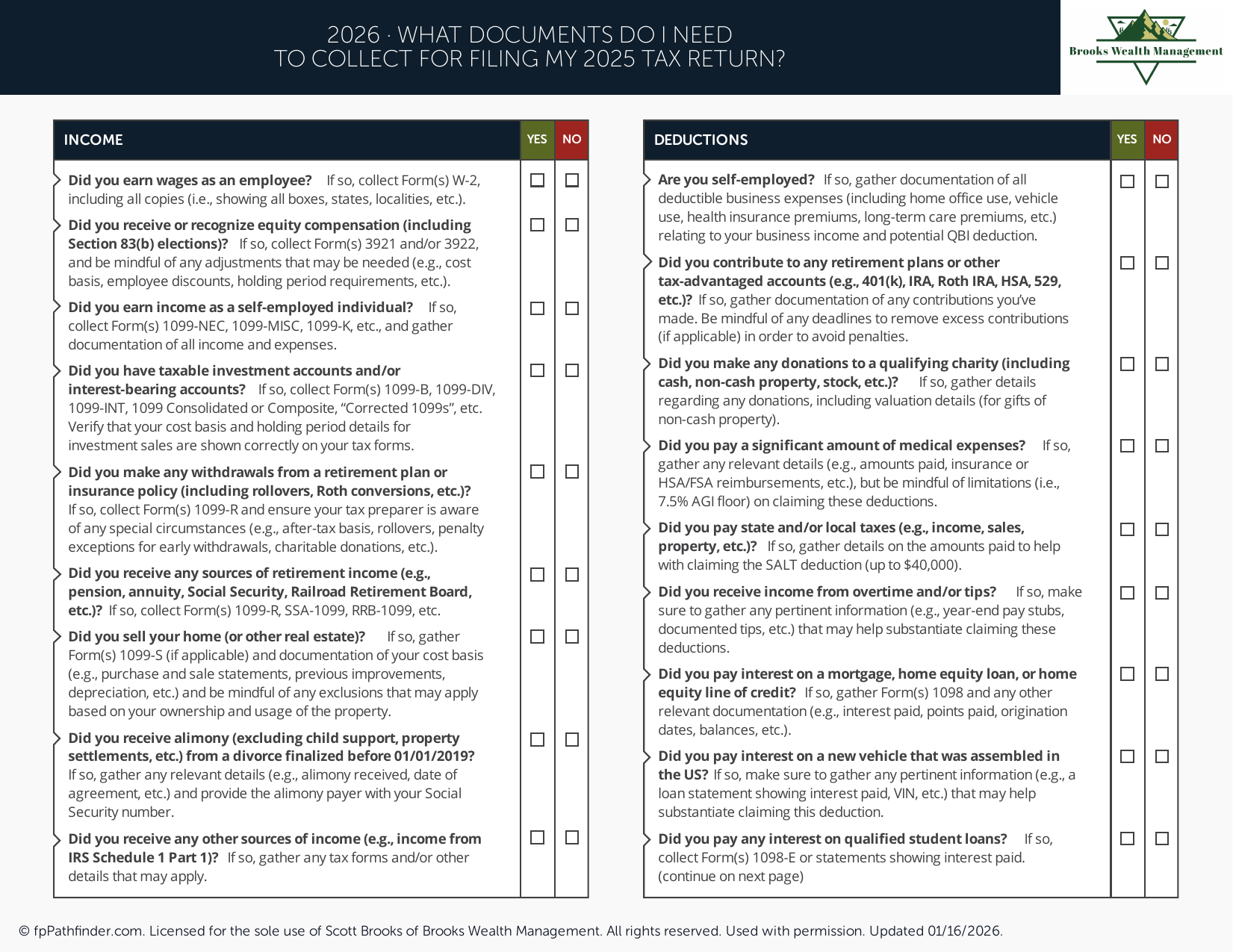
What Tax Documents Should I Gather Before Filing My Tax Return?
Preparing for tax season often begins with gathering the documents needed to complete an accurate tax return. Having organized records may help reduce delays, minimize errors, and provide a more complete picture of your financial activity during the year.
The specific documents required will depend on your sources of income, investments, deductions, business activities, and other personal circumstances. This guide outlines many of the documents taxpayers commonly review before filing a federal income tax return.
Income Documents
Most tax returns begin with reporting income earned throughout the year. Common income-related documents may include:
- Form W-2 for wages, salary, bonuses, and other employee compensation.
- Form 1099-NEC for nonemployee compensation and independent contractor income.
- Form 1099-MISC for certain miscellaneous income.
- Form 1099-K for certain payment card and third-party network transactions.
- Schedule K-1 for income from partnerships, S corporations, estates, or trusts.
- Social Security benefit statements for individuals receiving Social Security benefits.
- Unemployment compensation statements, if applicable.
Reviewing income documents for completeness may help ensure all reportable income is properly reflected on a tax return.
Investment and Brokerage Documents
Individuals with investment accounts may receive several tax forms related to investment activity.
- Form 1099-B reporting proceeds from securities sales.
- Form 1099-DIV reporting dividend income.
- Form 1099-INT reporting interest income.
- Form 1099-OID reporting original issue discount income.
- Brokerage year-end tax summaries and supplemental statements.
These documents may be useful when reporting capital gains, losses, dividends, interest income, and other investment-related transactions.
If you are evaluating broader tax planning opportunities, you may find our resource on Roth conversions helpful.
Retirement Account Documents
Taxpayers who contribute to or receive distributions from retirement accounts may receive additional reporting forms.
- Form 1099-R for distributions from IRAs, pensions, annuities, and employer retirement plans.
- Form 5498 reporting IRA contributions and account information.
- Retirement account statements that may assist with recordkeeping and planning.
Retirement-related documents may help support accurate reporting of contributions, rollovers, distributions, and conversions.
Homeownership and Loan Documents
Homeowners and borrowers may receive tax documents associated with mortgage interest, property taxes, or education loans.
- Form 1098 reporting mortgage interest paid.
- Property tax records where applicable.
- Form 1098-E reporting student loan interest paid.
- Closing statements related to the purchase or sale of real estate.
Individuals who sold a residence or other real property during the year may also wish to retain settlement statements and supporting records.
Health Savings Account (HSA) Documents
Individuals participating in a Health Savings Account may receive forms related to contributions and distributions.
- Form 1099-SA reporting HSA distributions.
- Form 5498-SA reporting HSA contributions.
- Qualified medical expense records supporting tax-free distributions.
Maintaining documentation related to HSA activity may be important for substantiating distributions and contributions.
Deduction and Credit Documentation
Some taxpayers may benefit from maintaining records related to deductions and tax credits.
- Charitable contribution receipts and acknowledgment letters.
- Medical expense records.
- Education expense records and Form 1098-T.
- Childcare expense documentation.
- Records of estimated tax payments.
- Business expense records for self-employed individuals.
Requirements for substantiating deductions and credits vary depending on the specific tax provision and individual circumstances.
Business Owner and Self-Employed Considerations
Business owners, independent contractors, and self-employed individuals often maintain additional records beyond standard tax forms.
Examples may include profit and loss statements, business bank account records, expense documentation, payroll reports, depreciation schedules, vehicle mileage records, and supporting documentation for business deductions.
Because business-related tax reporting can involve additional complexity, maintaining organized records throughout the year may simplify the filing process.
Organizing Tax Records
Many taxpayers maintain a dedicated folder—either digital or physical—for annual tax documents. Organizing records as they are received may help reduce the likelihood of missing information when preparing a return.
Tax records may also provide useful information for broader financial planning discussions involving cash flow, investments, retirement planning, and tax planning opportunities.
For additional financial planning resources, visit our free resource library. If you are evaluating opportunities to increase savings, you may also find our guide on accounts to consider if you want to save more helpful.
About This Resource
This resource provides general educational information regarding tax documents, tax return preparation, and financial recordkeeping. Every individual's circumstances are different, and tax filing requirements should be evaluated based on applicable laws, personal circumstances, and guidance from qualified tax professionals.
Brooks Wealth Management works with professionals, business owners, retirees, and families on a wide range of financial planning topics, including tax-aware financial planning and wealth management. If you would like to discuss your situation, we invite you to schedule an introductory conversation or learn more about our approach on our pricing page.
Have Questions About Your Situation?
This resource is intended for educational purposes only. If you would like to discuss your circumstances, schedule an introductory conversation with Scott Brooks, CFP®.
Schedule an Introductory ConversationVentura County, California · Serving Clients Throughout California and Across the United States
Brooks Wealth Management is a Registered Investment Adviser registered with the State of California. Registration does not imply a certain level of skill or training. This content is provided for informational and educational purposes only and should not be construed as investment, tax, legal, or accounting advice. Advisory services are offered only to clients or prospective clients where Brooks Wealth Management and its representatives are properly licensed or exempt from licensure. Investing involves risk, including the potential loss of principal. CFP® is a certification mark owned by the Certified Financial Planner Board of Standards, Inc. Scott Brooks, CFP® · CRD #7227609 · Firm CRD #332237