
Do I Need to Start Making Estimated Federal Income Tax Payments?
Flowchart to determine whether you are required to make quarterly estimated federal income tax payments.
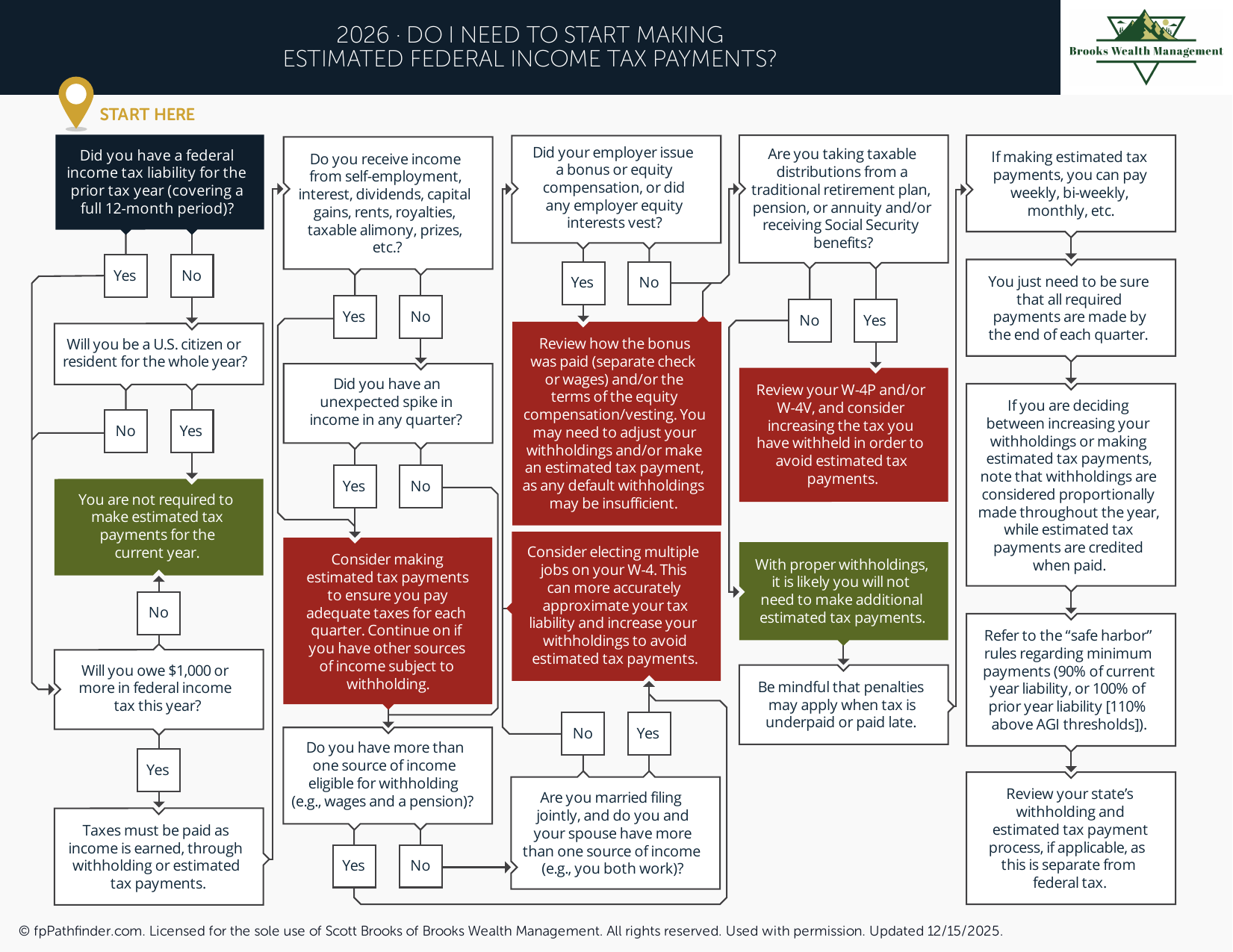
Do I Need to Make Estimated Tax Payments?
The federal income tax system generally operates on a pay-as-you-go basis, meaning taxes are typically paid throughout the year as income is earned. While many employees satisfy this requirement through payroll withholding, some individuals may need to make estimated tax payments if they receive income that is not subject to sufficient withholding.
Understanding when estimated tax payments may be required can help individuals evaluate their tax obligations and avoid unexpected balances due when filing a tax return.
What Are Estimated Tax Payments?
Estimated tax payments are periodic payments made directly to the Internal Revenue Service (IRS) during the year. These payments are generally intended to cover federal income tax obligations on income that is not subject to adequate withholding.
Common sources of income that may require estimated tax payments include self-employment income, business income, investment income, rental income, retirement income, and certain other forms of taxable income.
Who May Need to Make Estimated Tax Payments?
Whether estimated tax payments are required depends on an individual's specific tax situation, expected tax liability, withholding amounts, credits, and other factors.
Individuals who commonly review estimated tax requirements include:
- Self-employed individuals and independent contractors.
- Business owners receiving pass-through income.
- Individuals with significant investment income.
- Individuals receiving rental income.
- Retirees with income not subject to withholding.
- Individuals receiving substantial bonus, equity compensation, or other supplemental income.
Because tax rules can be complex and individual circumstances vary, taxpayers may benefit from reviewing their situation with qualified tax professionals.
Understanding Safe Harbor Rules
The IRS provides various rules that may help taxpayers avoid underpayment penalties when making estimated tax payments. These rules are commonly referred to as "safe harbor" provisions.
Safe harbor calculations may depend on factors such as prior-year tax liability, current-year income, filing status, and adjusted gross income. Because these calculations can vary from person to person, taxpayers should consult current IRS guidance or qualified tax professionals when evaluating estimated payment requirements.
Individuals with substantial income fluctuations during the year may have additional planning considerations related to estimated taxes.
Common Sources of Income That May Create Estimated Tax Obligations
Income that is not subject to sufficient withholding may increase the likelihood that estimated tax payments are required.
Examples may include:
- Self-employment income.
- Partnership and S corporation income reported on Schedule K-1.
- Interest and dividend income.
- Capital gains from investment sales.
- Rental property income.
- Retirement account distributions.
- Certain forms of equity compensation.
Taxpayers with multiple income sources often review their overall withholding and projected tax liability throughout the year to determine whether adjustments may be appropriate.
Estimated Tax Payments and Equity Compensation
Individuals receiving stock options, restricted stock units (RSUs), employee stock purchase plan (ESPP) shares, bonuses, or other forms of compensation may experience periods when withholding does not fully cover their ultimate tax liability.
Depending on the circumstances, additional tax planning may be appropriate to evaluate potential tax obligations associated with equity compensation and other variable income sources.
If you are evaluating broader tax planning opportunities, you may find our resource on Roth conversions helpful.
Reviewing Tax Withholding During the Year
For some individuals, adjusting payroll withholding may be an alternative to making separate estimated tax payments. Others may choose to use a combination of withholding adjustments and estimated payments depending on their income sources and tax situation.
Reviewing income, withholding, and projected tax liability periodically throughout the year may help identify potential issues before a tax return is filed.
Estimated Tax Payments and Financial Planning
Estimated tax obligations can affect cash flow, savings decisions, retirement planning, business planning, and investment management. As a result, many individuals evaluate tax payments within the context of a broader financial plan.
Business owners, professionals, retirees, and investors often benefit from coordinating tax planning decisions with broader financial planning objectives.
For additional financial planning resources, visit our free resource library. If you are evaluating opportunities to increase savings, you may also find our guide on accounts to consider if you want to save more helpful.
When Professional Guidance May Be Helpful
Estimated tax requirements can involve multiple variables, including withholding, business income, investment income, retirement distributions, and tax law changes. Individuals evaluating estimated tax obligations may benefit from coordinating with qualified tax professionals and financial advisors.
Brooks Wealth Management works with professionals, business owners, retirees, and families on a wide range of financial planning topics, including tax-aware financial planning and wealth management. You can learn more about our approach on our pricing page.
About This Resource
This resource provides general educational information regarding estimated tax payments, withholding, and federal income tax concepts. Every individual's circumstances are different, and tax obligations should be evaluated based on personal income sources, tax considerations, and applicable laws.
If you would like to discuss your situation, we invite you to schedule an introductory conversation.
Have Questions About Your Situation?
This resource is intended for educational purposes only. If you would like to discuss your circumstances, schedule an introductory conversation with Scott Brooks, CFP®.
Schedule an Introductory ConversationVentura County, California · Serving Clients Throughout California and Across the United States
Brooks Wealth Management is a Registered Investment Adviser registered with the State of California. Registration does not imply a certain level of skill or training. This content is provided for informational and educational purposes only and should not be construed as investment, tax, legal, or accounting advice. Advisory services are offered only to clients or prospective clients where Brooks Wealth Management and its representatives are properly licensed or exempt from licensure. Investing involves risk, including the potential loss of principal. CFP® is a certification mark owned by the Certified Financial Planner Board of Standards, Inc. Scott Brooks, CFP® · CRD #7227609 · Firm CRD #332237