
What Issues Should I Consider When Harvesting Capital Losses?
Checklist of wash-sale rules, tax impact, and portfolio considerations when harvesting capital losses.
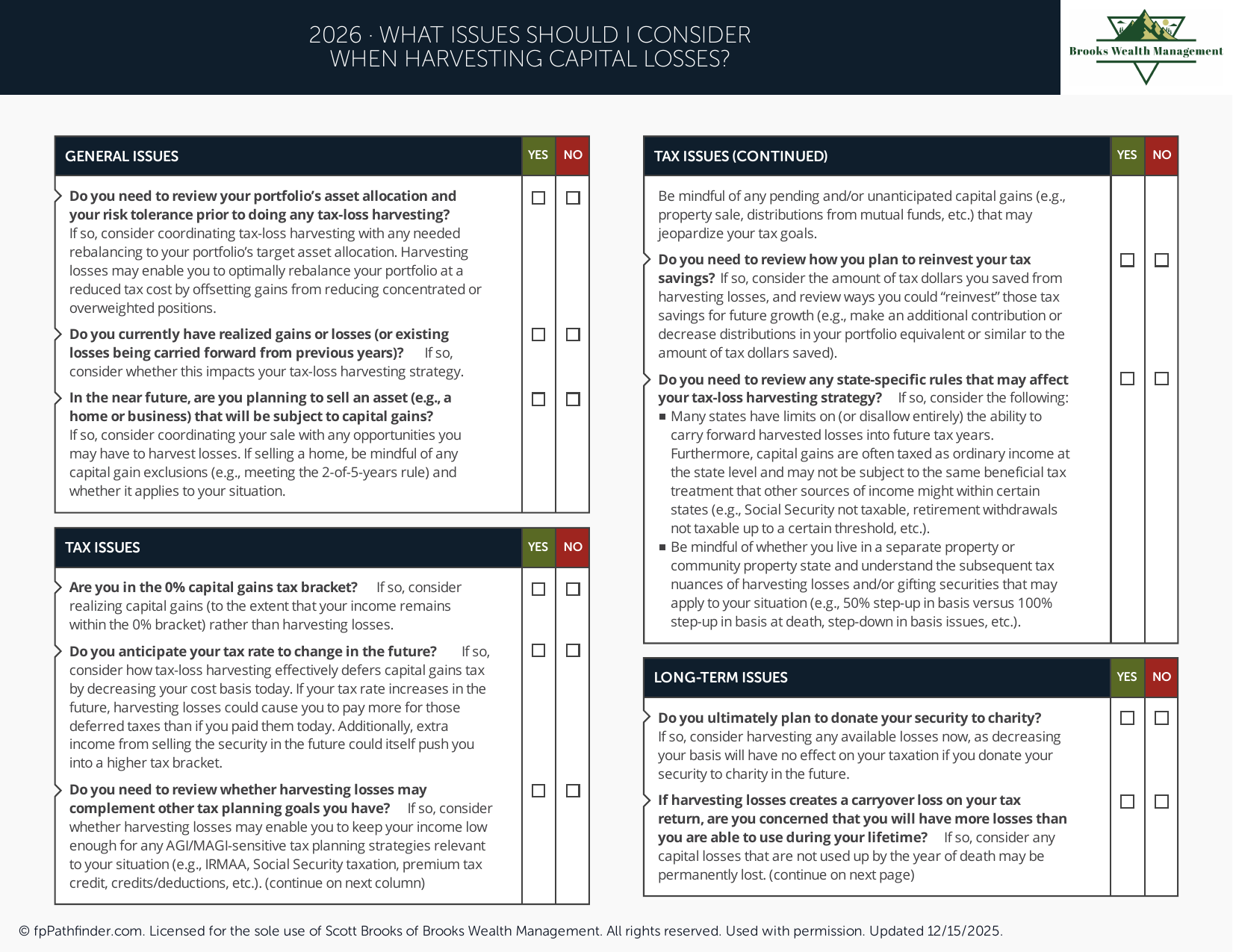
What Issues Should I Consider When Reviewing Capital Loss Harvesting?
Capital loss harvesting is a tax-planning strategy that involves realizing investment losses to offset capital gains and, in certain situations, a limited amount of ordinary income.
Individuals reviewing capital loss harvesting often consider several tax, investment, and reporting issues before implementing the strategy.
Review How Capital Loss Harvesting Works
Capital losses may be used to offset capital gains realized during the same tax year.
Individuals commonly review:
- Current year capital gains
- Current year realized losses
- Short-term capital gains and losses
- Long-term capital gains and losses
- Potential loss carryforwards
If total capital losses exceed total capital gains, a portion of the excess loss may be used to offset ordinary income, subject to applicable IRS limitations.
Review the Wash Sale Rule
The wash sale rule may affect the deductibility of certain realized losses.
Individuals often review:
- Purchases made within 30 days before a sale
- Purchases made within 30 days after a sale
- Transactions involving substantially identical securities
- Activity across taxable accounts
- Activity occurring in retirement accounts
If a wash sale occurs, all or part of a realized loss may be disallowed under current IRS rules.
Review Portfolio Allocation Considerations
Capital loss harvesting may affect the composition of an investment portfolio.
Common considerations include:
- Asset allocation objectives
- Diversification considerations
- Investment replacement options
- Risk tolerance
- Long-term investment goals
Some individuals review whether a potential tax benefit aligns with their overall investment strategy.
Review Capital Loss Carryforward Opportunities
Unused capital losses may generally be carried forward to future tax years.
Individuals often review:
- Existing loss carryforwards
- Future capital gain expectations
- Projected taxable income
- Potential future tax rates
Loss carryforwards may be available indefinitely under current federal tax law, subject to applicable rules.
Review Tax Reporting Requirements
Capital gains and losses are generally reported on federal income tax returns.
Individuals commonly review:
- Cost basis records
- Purchase and sale dates
- Trade confirmations
- Form 1099-B reporting
- Schedule D reporting requirements
- Form 8949 reporting requirements
Maintaining accurate records may assist with tax reporting and documentation requirements.
Review Potential Tax Planning Considerations
Capital loss harvesting may be one component of a broader tax-planning strategy.
Additional considerations may include:
- Roth conversion planning
- Charitable giving strategies
- Retirement account withdrawals
- Required Minimum Distributions
- Tax bracket management
- Estate planning considerations
For additional information, review our resources on Roth conversions, retirement withdrawal strategies, and our free resources.
About This Resource
This resource provides general educational information regarding capital loss harvesting. Tax laws are subject to change and individual circumstances may vary. This information should not be interpreted as tax, legal, investment, or financial advice.
If you would like to discuss how tax-planning strategies fit within your broader financial plan, we invite you to schedule an introductory conversation.