
What Issues Should I Consider When Planning for the Sale, Disposition, or Succession of My Business?
Checklist of tax, legal, and financial planning steps when preparing to sell or transfer a business.
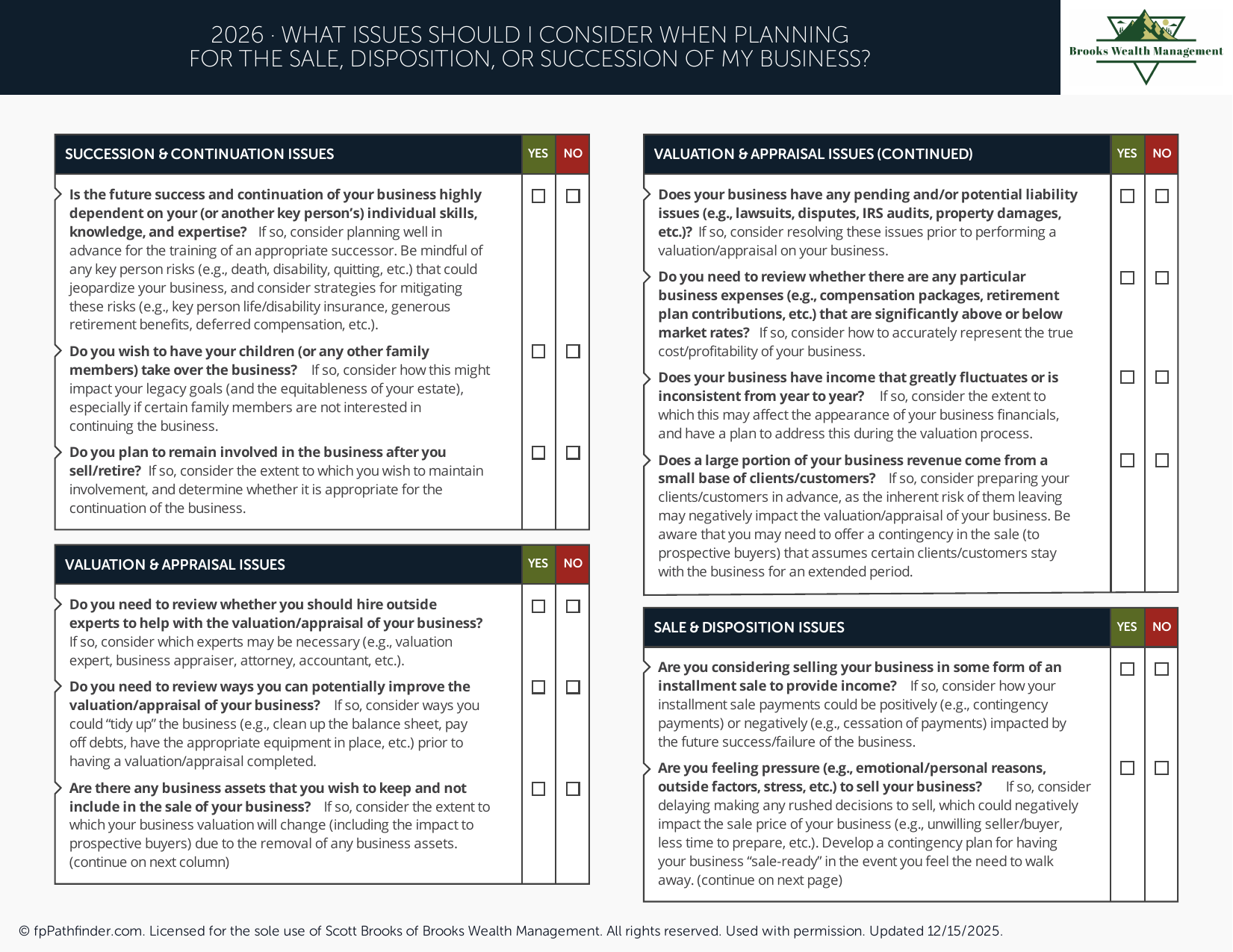
Navigating Business Succession Planning: A Comprehensive Guide for 2026
As a business owner, the day may eventually come when you consider the sale, transfer, or succession of your business. This transition can represent one of the most significant financial events of your life and often requires thoughtful planning well in advance. Effective business succession planning can help align your personal goals, financial objectives, and long-term vision for the future of your company. Whether your goal is to transfer ownership to family members, key employees, a third-party buyer, or another successor, having a plan in place may help create greater flexibility and clarity throughout the process.
Defining Your Vision for Business Succession Planning
Before evaluating specific transition strategies, it is important to identify your personal and financial priorities. What would a successful transition look like for you and your family? Are you primarily focused on maximizing after-tax proceeds, preserving company culture, rewarding employees, maintaining family ownership, or creating a lasting legacy? Your answers will help shape the planning process and influence the strategies considered. Establishing clear objectives early can help ensure future decisions remain aligned with your broader goals.
For some owners, that may involve a sale to an outside buyer. For others, it may mean transferring ownership to family members, implementing a management buyout, or exploring an Employee Stock Ownership Plan (ESOP). Understanding your desired outcome is often one of the most important first steps in the business succession planning process.
Financial and Tax Considerations
The financial and tax implications of selling or transferring a business can be significant. Understanding the value of your business is often an important starting point, as it provides a framework for evaluating transition opportunities and retirement planning needs. Depending on the circumstances, different transaction structures may result in different tax consequences.
Working with qualified tax professionals, valuation specialists, and legal counsel can help business owners better understand available options and make informed decisions. Because every situation is unique, planning well before a potential transaction may provide additional flexibility and allow more time to evaluate available strategies. For more educational materials and planning resources, explore our free resources.
Legal and Operational Preparation
A successful business transition extends beyond financial considerations. Legal documents, ownership agreements, contracts, key employee relationships, and operational processes may all play an important role in a future transfer. Businesses that have documented systems, established management structures, and clearly defined processes may be better positioned for continuity during a transition.
Business owners should consider working with experienced legal and tax professionals to review succession-related documents and identify potential areas requiring attention before a transition occurs.
Preparing for Life After the Business
Many business owners spend years—or even decades—building their companies. As a result, succession planning often includes both financial and personal considerations. Transitioning away from a business can affect lifestyle, daily routines, future goals, and long-term financial planning.
Developing a plan for the next chapter can be just as important as preparing the business itself. A comprehensive financial plan can help business owners evaluate how a future transition may affect retirement income needs, investment planning, charitable goals, estate planning considerations, and other long-term objectives.
About This Resource
This article provides a general overview of business succession planning concepts and considerations. Every business owner's situation is unique and may require a customized approach. Brooks Wealth Management works with business owners, professionals, retirees, and families to help coordinate financial planning decisions as part of a broader wealth management strategy.
If you would like to discuss your situation, we invite you to book a consultation.
Have Questions About Your Situation?
This resource is a starting point. A consultation with Scott Brooks, CFP® can help you evaluate how these concepts may apply to your circumstances.
Book a ConsultationVentura County, California · Serving Clients Across the United States
Brooks Wealth Management is a Registered Investment Adviser registered with the State of California. Registration does not imply a certain level of skill or training. This content is provided for informational and educational purposes only and should not be construed as investment, tax, legal, or accounting advice. Advisory services are offered only to clients or prospective clients where Brooks Wealth Management and its representatives are properly licensed or exempt from licensure. Investing involves risk, including the potential loss of principal. CFP® is a certification mark owned by the Certified Financial Planner Board of Standards, Inc. Scott Brooks, CFP® · CRD #7227609 · Firm CRD #332237