
Can I Do a Section 1031 Exchange with My Rental Property?
Flowchart to determine eligibility and rules for a like-kind exchange of rental or investment property.
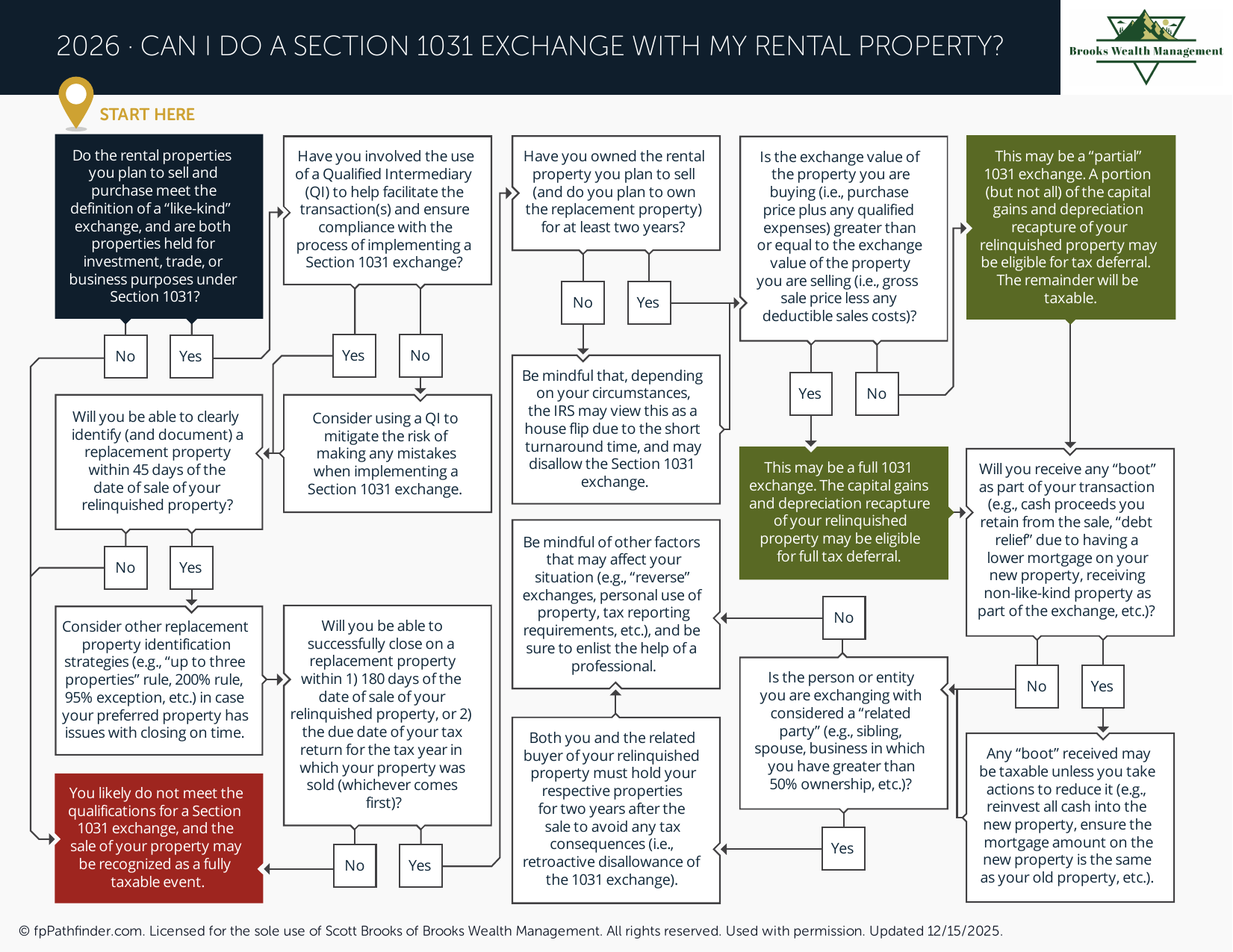
Can You Use a 1031 Exchange With a Rental Property?
A Section 1031 exchange is a tax-deferral strategy that may allow investors to exchange certain real property held for investment or business purposes for other qualifying real property. When completed in accordance with applicable IRS rules, a 1031 exchange may allow taxes associated with the sale of an investment property to be deferred rather than recognized immediately.
Rental properties are among the most common types of real estate involved in Section 1031 exchanges. However, specific requirements must be satisfied for an exchange to qualify under current tax law.
What Is a Section 1031 Exchange?
Section 1031 of the Internal Revenue Code permits certain exchanges of real property held for investment or productive use in a trade or business. The rules governing 1031 exchanges can be complex and generally require strict compliance with identification, timing, and documentation requirements.
The purpose of a 1031 exchange is generally to allow investors to continue investing in real estate without immediately recognizing taxable gain when transitioning from one qualifying property to another.
Do Rental Properties Qualify for a 1031 Exchange?
In many cases, a rental property may qualify for a Section 1031 exchange if it is held for investment purposes or productive use in a trade or business.
Examples may include:
- Single-family rental homes.
- Multi-family residential properties.
- Commercial buildings.
- Industrial properties.
- Raw land held for investment.
- Certain other qualifying real estate interests.
Whether a specific property qualifies depends on the facts and circumstances, including how the property is used and the taxpayer's intent.
Understanding Like-Kind Property
For real estate exchanges, the term "like-kind" is generally interpreted broadly. Real property held for investment or business purposes may often be exchanged for other qualifying real property held for investment or business purposes.
Examples may include exchanging:
- A rental home for a multi-family property.
- A commercial property for vacant land.
- A residential investment property for a commercial building.
The determination of whether a property qualifies should be evaluated based on applicable tax rules and individual circumstances.
Important Timing Requirements
Section 1031 exchanges generally involve strict deadlines established by the Internal Revenue Code and related regulations.
Among the requirements commonly associated with 1031 exchanges are:
- A period for identifying potential replacement properties.
- A period for completing the acquisition of replacement property.
- Specific documentation and procedural requirements.
Failure to satisfy applicable timing requirements may result in the transaction becoming fully taxable.
The Role of a Qualified Intermediary
Many 1031 exchanges involve the use of a Qualified Intermediary (QI). A Qualified Intermediary generally facilitates the exchange process and helps ensure the taxpayer does not take direct receipt of exchange proceeds.
The selection of a Qualified Intermediary is an important part of the exchange process and may involve legal, operational, and financial considerations.
Potential Tax Considerations
A properly structured 1031 exchange may defer recognition of certain taxable gains. However, deferred taxes are not necessarily eliminated and may become relevant in future transactions depending on subsequent events and applicable tax rules.
Additional considerations may include:
- Capital gains taxes.
- Depreciation recapture.
- Debt replacement requirements.
- Cash received as part of the transaction.
- State-specific tax considerations.
Because tax outcomes vary based on individual circumstances, investors should consult qualified tax professionals before pursuing an exchange.
Common Issues Investors Review Before Completing a 1031 Exchange
Investors often evaluate a variety of factors before initiating an exchange, including:
- Long-term investment objectives.
- Property cash flow characteristics.
- Location and market considerations.
- Financing requirements.
- Portfolio diversification goals.
- Estate planning objectives.
These considerations are often reviewed within the context of a broader financial plan rather than solely as a tax decision.
If you are evaluating broader wealth transfer considerations, you may find our estate planning resources helpful. You may also wish to review our free resource library for additional educational content.
How a 1031 Exchange Fits Within a Financial Plan
A Section 1031 exchange may affect investment strategy, retirement planning, estate planning, tax planning, liquidity needs, and overall portfolio management.
As a result, many investors evaluate potential exchanges alongside other financial goals and planning considerations. Understanding how real estate holdings fit within an overall financial plan may help provide additional context when evaluating available options.
When Professional Guidance May Be Helpful
Section 1031 exchanges involve tax rules, legal considerations, transaction deadlines, and real estate-specific requirements. Investors considering a 1031 exchange may benefit from coordinating with qualified tax professionals, legal counsel, real estate professionals, and financial advisors.
Brooks Wealth Management works with professionals, business owners, retirees, and families on a wide range of financial planning topics, including tax-aware financial planning, retirement planning, investment management, and wealth management. You can learn more about our approach on our pricing page.
About This Resource
This resource provides general educational information regarding Section 1031 exchanges and investment real estate. Every individual's circumstances are different, and real estate decisions should be evaluated based on personal goals, tax considerations, investment objectives, and applicable laws.
If you would like to discuss your situation, we invite you to schedule an introductory conversation.
Have Questions About Your Situation?
This resource is intended for educational purposes only. If you would like to discuss your circumstances, schedule an introductory conversation with Scott Brooks, CFP®.
Schedule an Introductory ConversationVentura County, California · Serving Clients Throughout California and Across the United States
Brooks Wealth Management is a Registered Investment Adviser registered with the State of California. Registration does not imply a certain level of skill or training. This content is provided for informational and educational purposes only and should not be construed as investment, tax, legal, or accounting advice. Advisory services are offered only to clients or prospective clients where Brooks Wealth Management and its representatives are properly licensed or exempt from licensure. Investing involves risk, including the potential loss of principal. Real estate investments involve risk and may lose value. CFP® is a certification mark owned by the Certified Financial Planner Board of Standards, Inc. Scott Brooks, CFP® · CRD #7227609 · Firm CRD #332237