
Brooks Wealth Management

Week of June 8th, 2026

What a world we live in.

Honestly, I'm not sure there's a better way to put it. We are living through one of the most fascinating, and at times exhausting, periods in modern financial history.

On one hand, the stock market is sitting near all time highs. Corporate earnings have never been better. We just watched the largest IPO in history hit the market. And this stretch of double digit returns, year after year, is its own kind of historic.

On the other hand, we've got ongoing geopolitical conflict in the Middle East directly moving oil prices and inflation. Interest rates are sitting at levels we haven't seen in years, with a brand new Fed chair about to hold his first meeting right in the middle of it all. And underneath the surface, cracks are showing in the U.S. savings rate, income growth, job layoffs, delinquencies, and consumer sentiment, the kind of things that, on paper, would not usually line up with markets at all time highs.

Which is really just further proof of something worth remembering: the stock market and the economy are not the same thing.

Unprecedented has become such an overused word that it's almost lost its meaning, and yet here we are again, using it. Maybe that is just the new normal and I find it genuinely exciting to be around for it. There's never been a more important time to stay informed, stay grounded, and keep asking good questions.

This newsletter is packed with content I think you'll enjoy. As always, reach out with any questions!

Market Notes

The Last Two Weeks

It's been a busy stretch, so let's zoom out and cover the last couple weeks together.

The week of June 8th started with stocks finally hitting a wall after an impressive ten-week winning streak. The S&P 500 had crossed 7,600 for the first time, then dropped about 2.6% the following Friday on a jobs report that was almost too good. Stronger-than-expected job gains spooked investors who started pricing in the possibility of a Fed rate hike, which is one of those only-in-this-environment situations where good economic news sends stocks lower. The Nasdaq fell 3.4%, led lower by AI-linked names, though energy and healthcare both held up well.

Then came inflation data. May CPI rose 4.2% year over year, its biggest annual increase in three years, driven largely by higher energy prices. The headline number was in line with expectations, but it's the first time we've seen a 4% handle on inflation in a while, and that triggered another leg lower for stocks on Tuesday and Wednesday. The Dow fell over 900 points and the Nasdaq dropped nearly 2% on the day of the CPI release. Core CPI, which strips out food and energy, actually came in a touch below expectations at 2.9%, which offered a little reassurance underneath the headline noise.

Then this week took an interesting turn. By Friday, markets were on track for a positive week, rebounding on hopes that a peace deal could be near that would lift sanctions on Iran and reopen the Strait of Hormuz, with crude oil falling about 2% toward $85 per barrel. So we went from a sharp inflation-driven selloff to a geopolitical-relief rally in the span of about 48 hours. That's the kind of whiplash that's become pretty normal lately.

SpaceX Goes Public

And then there's SpaceX. SpaceX began trading on the Nasdaq under the ticker SPCX on Friday, June 12, in what is being called the largest IPO in history, at a valuation of roughly $1.75 trillion. Whatever your view on the company, an IPO of that size landing in the middle of an already eventful couple of weeks is a historic moment for markets, and it's worth watching how it trades in its first few sessions, both for its own sake and for what it might signal about investor appetite for big new listings.

Bonds and Rates

On the fixed income side, the 10-year Treasury yield broke back above 4.50% during the selloff, a level I've been watching closely. Historically, that's been a tipping point. When rates get and stay above 4.50%, it tends to tighten financial conditions and put pressure on stock valuations. The Bloomberg Aggregate Bond Index fell about 0.54% over the period, while investment-grade corporates also gave ground.

The bottom line: a resilient labor market combined with a hotter-than-expected inflation print has shifted investor focus back toward inflation persistence rather than growth concerns, and that's pushing the "higher for longer" narrative back into the conversation. Any hopes for near-term Fed cuts got quietly shelved.

What I am Watching Over the Next 30 Days

The next 30 days are going to be interesting. There are a few key events and data points on the calendar that I think will set the tone for markets through the rest of the summer.

The Fed Meeting (June 16-17)

This is the big one. The FOMC decision lands Wednesday, June 17, marking new Fed Chair Kevin Warsh's first meeting in the seat, with the rate widely expected to hold at 3.50% to 3.75%. What matters just as much as the decision itself is the language and the dot plot. The risk has flipped: fed funds futures now price a rate hike, not a cut, as the more likely year-end move, and Warsh may scrap the dot plot altogether at this meeting. Watch the press conference closely, both for tone and for how he frames the path forward given the recent inflation surprise.

Inflation Data Keeps Coming

PPI for May follows CPI by a day, landing directly in the committee's deliberation window, and May retail sales release on decision-day morning itself. So the Fed will be digesting a fresh batch of data right up until the moment they speak. If inflation data continues to run hot, expect the "higher for longer" conversation to get louder. If it cools even modestly, that could open the door to a more measured tone.

Energy Prices and the Middle East

Disruptions to Strait of Hormuz transit remain a key risk on the calendar, but this week showed how quickly that can swing both directions. Energy prices have already been a quiet pressure point on inflation, and any further escalation could ripple through quickly. On the flip side, continued progress toward a peace deal could bring oil prices down meaningfully and give the Fed more breathing room on the inflation side of its mandate.

The Bigger Picture

The next 30 days will likely answer one important question: was the early-June pullback just a healthy pause after a long run, or the start of something more meaningful? The Fed's tone, incoming inflation data, the labor market, and how a $1.75 trillion IPO digests into the market will all be worth watching. I'll keep a close eye on all of it and keep you updated as things develop.

Planning Takeaway

So what does all of this actually mean for you? Here's how I'm thinking about it from a planning perspective.

Don't Let the Noise Drive Decisions

In the span of about a week, we went from a ten-week win streak, to a sharp selloff on a hot inflation print, to a relief rally on Middle East headlines, with the largest IPO in history thrown in for good measure. That's a lot to process, and that's exactly the point. If your portfolio is built around your goals and time horizon, none of this should change anything about your plan.

Keep Some Dry Powder

Markets have had a tremendous run this year. After ten straight weeks of gains, a pullback was not only possible, it was healthy. If you've been sitting on cash waiting for a better entry point, moments like this are exactly what you've been waiting for. Not to go all in, but to put money to work thoughtfully and systematically.

Revisit Your Plan if Your Life Has Changed

The market conversation can sometimes overshadow the more important one. If anything has changed in your life over the past few months (income, expenses, timeline, goals) that's the real reason to have a conversation. Markets will do what markets do. What matters most is that your financial plan still reflects your actual life.

As always, if any of this raises questions specific to your situation, reach out. That's what I'm here for.

Stop Waiting for the Perfect Moment to Invest

Why I made this video

This is one of the most common conversations I have with clients, and honestly one of the most important. When there's cash sitting on the sidelines waiting to be put to work, the instinct is almost always the same: wait for a better entry point. Wait for a pullback. Wait for things to feel less uncertain. And I get it. That instinct feels responsible. But the data tells a very different story.

We're at near highs right now, and that makes a lot of people uncomfortable about putting money in. But here's the thing: all time highs tend to breed more all time highs. The market doesn't owe us a pullback before it moves higher, and waiting for one that may never come is its own kind of risk. Time in the market has historically beaten timing the market, and this video is my attempt to show you exactly why. If you have cash to invest and you've been sitting on the fence, this one is for you.

Six charts that tell a story

1 Long-Term Perspective

The market has been through a lot worse than this

Why I'm sharing this

I like to come back to this one because it puts everything in perspective. Markets have lived through wars, recessions, financial crises, inflation scares, and policy shocks, and the long term trend has still been up and to the right. That doesn't mean headlines don't matter. They do. But it's a good reminder that the world doesn't have to feel calm for markets to keep working.

What this means for your plan

The point isn't to ignore risk. It's to avoid rebuilding your whole plan every time something feels urgent. A good plan already assumes uncomfortable stretches are part of the deal.

2 Recent Strength

A big rally doesn't mean the market is "due" for a fall

Why I'm sharing this

After a run like the one we've just had, it's natural to think the easy gains are behind us. But historically, big rallies haven't always meant the party's over. A lot of the time, strength tends to follow strength, especially when it's backed by real earnings growth and a decent economic backdrop.

What this means for your plan

Waiting for the "perfect" pullback sounds smart, but it can quietly turn into never being invested. If the money is for a long term goal, the better question isn't "is this the perfect entry point." It's "do I have a process for getting this money working."

3 Market Breadth

It's not just the Magnificent Seven anymore

Why I'm sharing this

For a while now, the market story has basically been a handful of mega cap tech names. And honestly, that made sense, because they drove most of the returns. But this chart is useful because it shows whether the rest of the market is starting to participate too.

What this means for your plan

Index funds are great, but they're not as diversified as people assume when a handful of names make up a huge chunk of the index. Worth knowing how much of your portfolio is leaning on the same few companies to keep doing the heavy lifting.

4 Leadership Rotation

Even the biggest winners take turns

Why I'm sharing this

This one adds a little nuance to the leadership conversation. Some of the names that crushed it the last few years haven't all moved together lately. A few have kept performing, others have lagged or even dropped. Good reminder that being in the "right theme" doesn't mean every stock in that theme behaves the same way.

What this means for your plan

Concentration can work great for a while, until it doesn't. Diversification feels boring when one or two names are running the show, but it matters a lot more once leadership starts to shift.

5 Investor Behavior

People can feel awful while the market does great

Why I'm sharing this

This might be my favorite chart of the bunch. Consumer sentiment can be in the dumps even while markets are climbing, and that gap matters because a lot of people use how they feel about the economy as a signal for what to do with their money. The problem is feelings tend to lag the market, sometimes by a lot.

What this means for your plan

You shouldn't need to feel good about the world before you stay invested. If your decisions are waiting for things to feel normal again, you'll usually end up reacting after the move has already happened.

6 Planning Reality

A strong market doesn't fix a thin cushion

Why I'm sharing this

This brings things back down to earth a bit. A rising market is great, but it doesn't automatically mean households have breathing room. When the savings rate is low, it usually means more of people's income is going toward spending, debt, housing, or lifestyle creep than they realize.

What this means for your plan

Returns matter, but cash flow matters first. A great portfolio can't fully make up for a savings rate that's too low. The strongest plans pair disciplined investing with enough liquidity and ongoing savings to handle real life when it shows up.

What Issues Should I Consider When Reviewing My Investments?
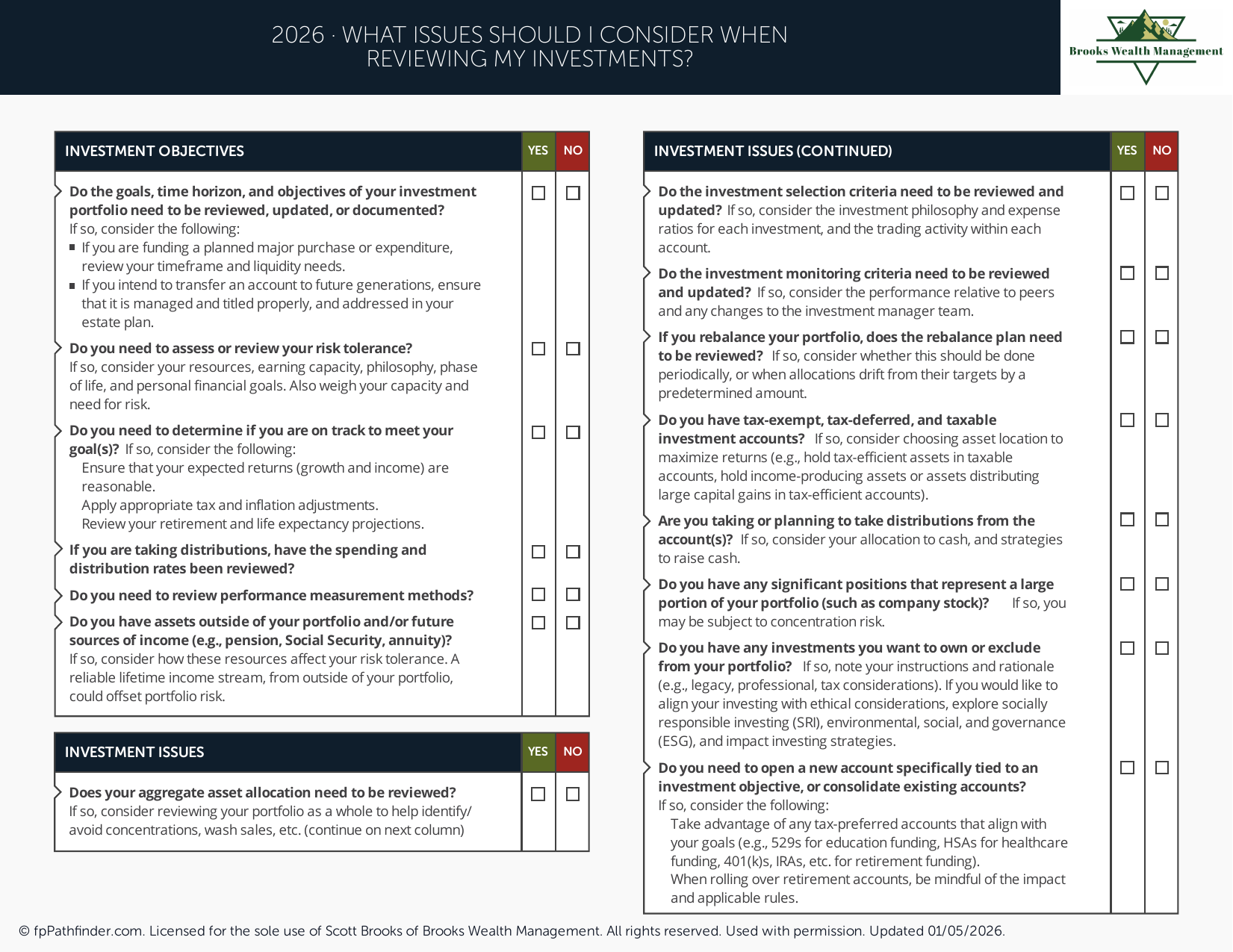
What Issues Should I Consider When Reviewing My Investments? preview
The content in this newsletter is for educational and informational purposes only and should not be construed as investment, tax, legal, or financial advice. The views expressed reflect the author's opinions as of the date of publication and are subject to change without notice. Past performance is not indicative of future results. All investing involves risk, including the possible loss of principal. This newsletter does not take into account your individual financial situation, goals, or needs. If you have questions about your specific circumstances, please reach out to a qualified financial advisor before making any financial decisions. Brooks Wealth Management is a Registered Investment Advisor. Registration does not imply a certain level of skill or training.
Scroll to Top